
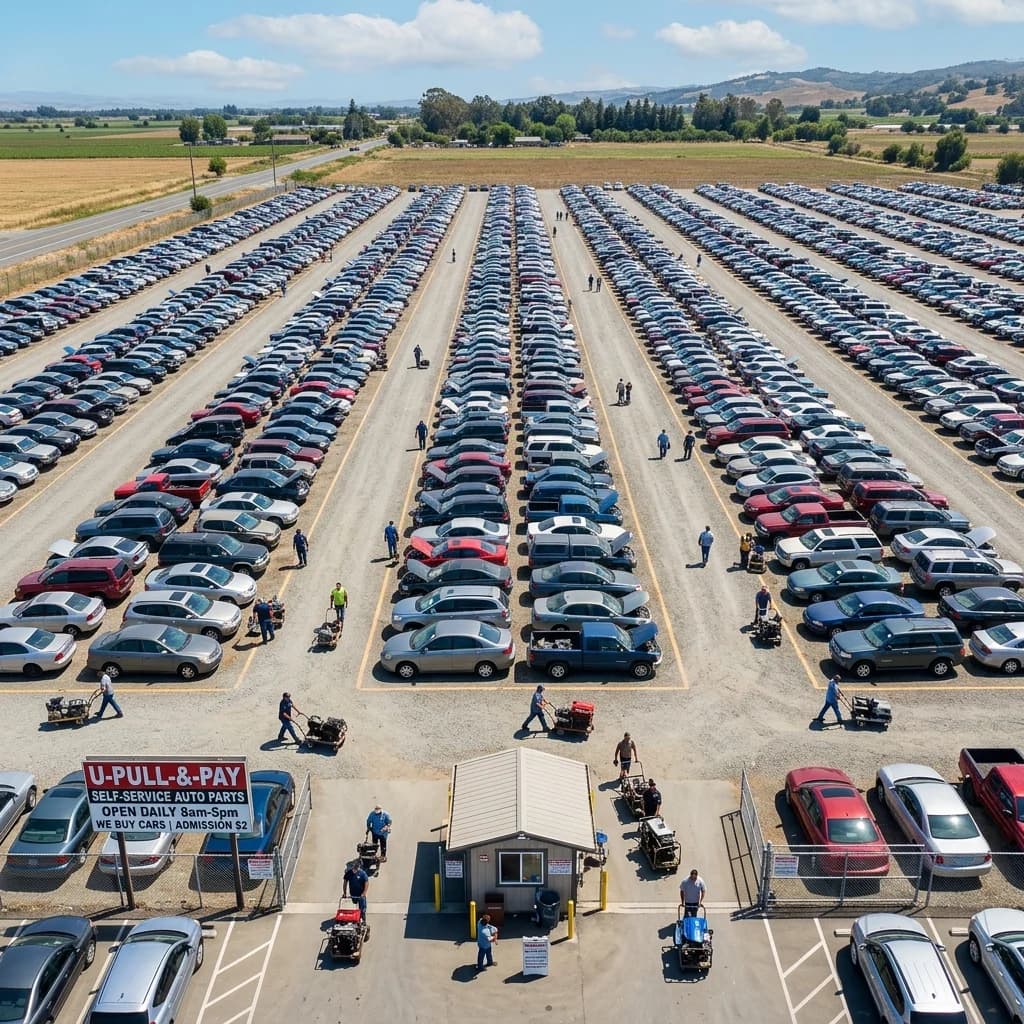
Key Takeaways
- Self-service yards: you pull the parts yourself with your own hand tools
- Parts priced by type, not by vehicle — a BMW alternator costs the same as a Honda alternator
- Typical savings: 70-90% off dealer parts pricing
- Check online inventory before going to verify your vehicle is in the yard
Step-by-Step: Your First Junkyard Visit
Step 1: Check Inventory Online
Before driving to the yard, search their online inventory. Most major chains (LKQ, Pick-n-Pull, Pull-A-Part) let you search by year, make, and model. You can see exactly which vehicles are in the yard, when they arrived, and at which location.
Step 2: Arrive Prepared
- Wear: Closed-toe boots, work clothes you don't mind getting dirty, gloves
- Bring: Socket set, wrenches, screwdrivers, penetrating oil, zip-lock bags for small parts
- Know: Your vehicle's year, make, model, and engine size. Know which side the part is on.
Step 3: Check In
At the entrance, you'll sign a liability waiver and pay an admission fee (typically $1-$2, some yards are free). You'll receive a map of the yard and sometimes a parts price list.
Step 4: Find Your Vehicle
Yards organize vehicles by make (all Hondas together, all Fords together, etc.) or by section number. Use the map or ask staff. Walk the rows until you find your target vehicle.
Step 5: Remove the Part
Use your tools to remove the part. Spray stubborn bolts with penetrating oil and wait 5-10 minutes. Take your time — rushing causes broken bolts and damaged parts.
Step 6: Check Out
Bring your part to the checkout counter. They'll identify it and charge the fixed price. You'll get a receipt that serves as your warranty documentation.
How Pricing Works
| Part Category | Typical Price Range | Dealer Equivalent | Your Savings |
|---|---|---|---|
| Engine (complete) | $200-$400 | $3,000-$6,000 | 90-95% |
| Transmission | $150-$300 | $2,000-$4,000 | 90-95% |
| Door (complete) | $50-$100 | $500-$1,200 | 85-95% |
| Fender | $30-$60 | $200-$600 | 85-90% |
| Headlight | $25-$50 | $200-$800 | 85-95% |
| Alternator | $25-$40 | $200-$500 | 85-92% |
| Starter | $20-$35 | $150-$400 | 85-90% |
| Radiator | $25-$40 | $200-$500 | 85-92% |
| Wheel (steel) | $20-$30 | $100-$200 | 80-85% |
| Side mirror | $15-$25 | $150-$500 | 85-95% |
Types of Junkyards
| Type | How It Works | Pricing | Best For |
|---|---|---|---|
| Self-Service (U-Pull) | You pull parts with your tools | Fixed by part type. Cheapest. | DIYers, mechanics, resellers |
| Full-Service | Staff pulls parts for you | Variable. 2-3x self-service | Specific parts, engines, transmissions |
| Online Salvage | Order online, shipped to you | Highest (includes shipping) | Hard-to-find parts, no local yards |
Ready to go? Find junkyards near you with our search tool. For a detailed tool list, read our what to bring to a junkyard guide. Compare major chains in our LKQ vs Pick-n-Pull comparison.