
Key Takeaways
- Dealer $800-$2,000. Reman $250-$600. Yard $40-$120
- The part number must match exactly. Close is not close enough on these
- Most post-2005 modules need VIN programming and a scan-tool bleed
- Wheel speed sensors fail far more often than modules. Rule them out first
Check the sensors before you buy anything
We sell a fair number of ABS modules to people who did not need one. The symptoms overlap almost completely with a failed wheel speed sensor, and the sensor is a $30 part.
| Pattern | Most likely |
|---|---|
| Code for one wheel only | That wheel's sensor, tone ring, or wiring |
| Codes on multiple wheels at once | Module, or a shared ground or power fault |
| Fault appears only over bumps | Chafed wiring, usually at the strut or wheel arch |
| Pump runs continuously | Module or a stuck valve |
| Light on from cold, clears when warm | Cracked solder joint inside the module |
| ABS, traction, and stability lights together | Module or its power supply |
Rusted tone rings deserve a specific mention. On many vehicles the toothed ring is pressed onto the hub or built into the bearing seal, and when it corrodes the signal drops out at low speed. The code names the sensor, the sensor tests fine, and the actual fix is a hub assembly. Inspect the ring before condemning anything electronic.
What has to match
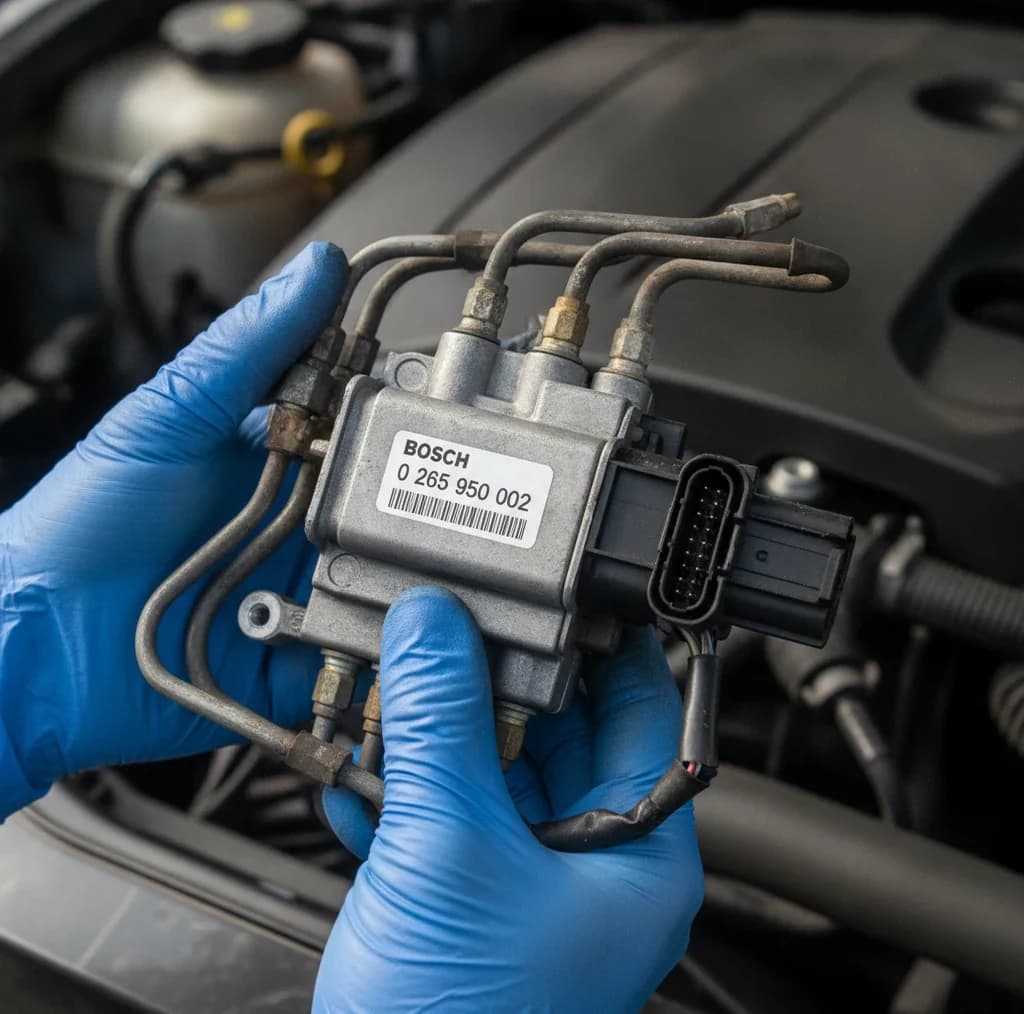
ABS modules look interchangeable and mostly are not. The hydraulic block and the electronic controller are calibrated together for a specific brake configuration.
- Full part number, every character. Manufacturers revise these mid-year. A suffix change can mean different valve timing.
- Traction and stability control. A stability-equipped module has extra valves and a yaw sensor input. The two are not interchangeable in either direction.
- Tone ring tooth count. Different wheel or brake packages sometimes use different counts, and the module's speed calculation depends on it.
- Brake system type. Rear drum versus rear disc changes the proportioning the module expects.
- Drivetrain. AWD modules handle four channels differently from front-wheel-drive units.
- Market and options. Hill-hold, trailer sway control, and adaptive cruise all change the calibration.
The practical approach at a yard: photograph the label on your module first, then match it character for character. Do not rely on the year and model.
Programming, and which cars need it
| Era and make | What is needed |
|---|---|
| Pre-2005, most makes | Often plug and play, manual bleed works |
| GM 2005+ | VIN write, scan-tool automated bleed |
| Ford 2006+ | Module configuration, scan-tool bleed |
| Toyota/Honda 2005+ | Usually plug and play, scan-tool bleed required |
| VW/Audi | Coding and adaptation, long coding string must be transferred |
| BMW/Mercedes | Programming tied to vehicle order, dealer-level tooling |
| Chrysler/RAM 2010+ | VIN write plus security PIN in some cases |
The bleed matters as much as the coding. Air trapped in the module's valve body will not come out with a conventional pedal bleed, because those passages are closed until the pump cycles them. A scan tool that can run the ABS bleed sequence is not optional on most modern systems, and it is the reason a shop charges $150-$400 for what looks like a two-bolt job.
Repair as an alternative
A large share of ABS module failures are cracked solder joints or a failed pump motor brush, not a dead controller. Several specialist companies rebuild modules on exchange for $150-$350 with a warranty, and because you send your own unit back, the VIN and coding stay intact. No programming needed.
That is often the better route on cars where coding is dealer-only. On a BMW or Mercedes, a $60 yard module plus dealer programming can cost more than a $300 rebuild of your own.
Pulling one at a yard
- Photograph the donor label next to your part number before you unbolt anything.
- Cap the lines immediately. Brake fluid absorbs moisture fast and contaminated fluid inside the valve body is a slow failure.
- Take the mounting bracket and rubber isolators. They are always cracked on your car and never sold separately.
- Check the connector pins for corrosion and the locking tab for damage.
- Note the donor mileage if the cluster still reads. The pump motor is the wear item.
- Avoid flood cars. Water sits in the connector and corrodes pins invisibly.