
Key Takeaways
- Identify by the code stamped on the case, not the model year
- Interchange follows the engine family, so Civic and Accord units do not swap
- Use Honda DW-1. Generic ATF is the most common cause of early failure
- The 1999-2004 V6 automatics are the ones with a genuine reputation problem
Find the code first
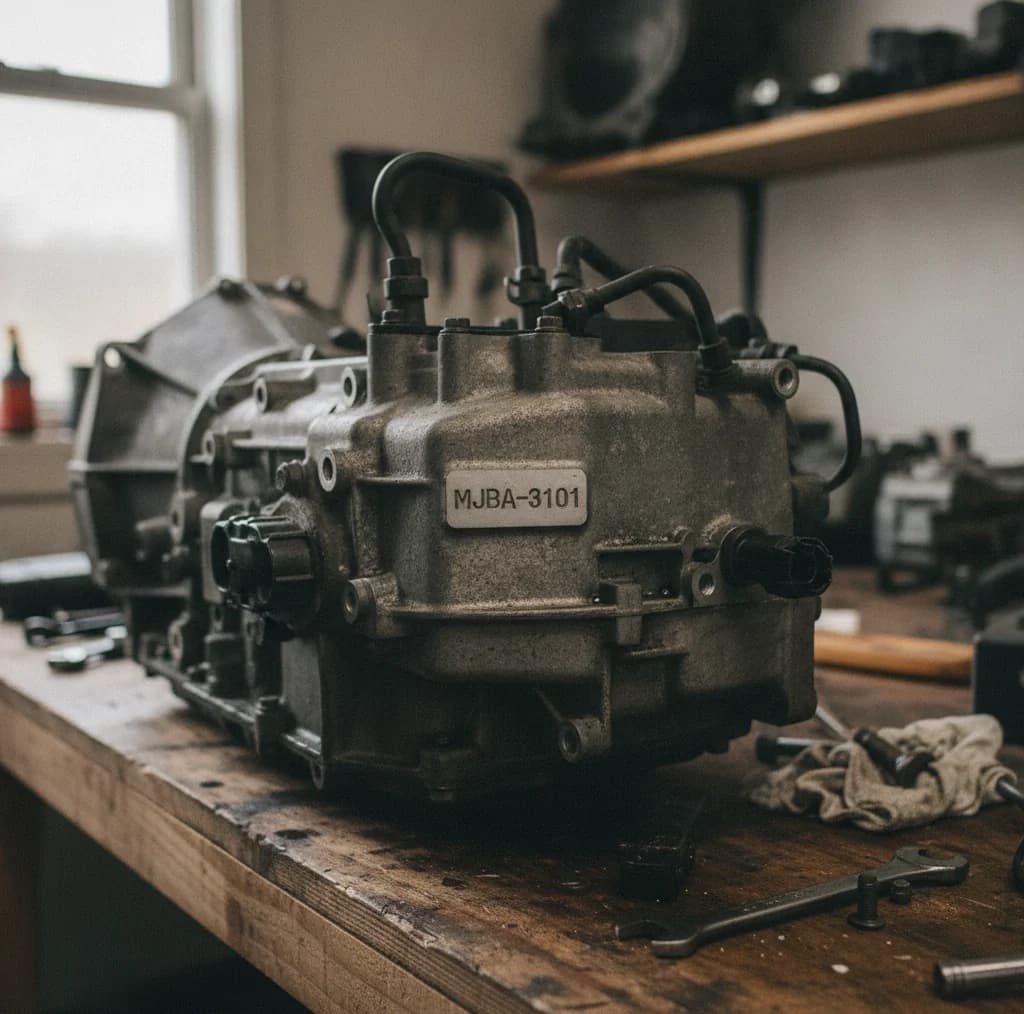
Honda stamps a short code on a flat machined pad on the transmission case, generally visible from above near the bellhousing or on the front face. It looks like BMXA, MDMA, SLXA, or similar.
That code identifies the exact unit including its final drive ratio and internal configuration. Two cars of the same year and model can carry different codes depending on trim and market, and a catalogue lookup by year will not catch it. Photograph yours before you go shopping.
What has to match
- Engine family. D, B, K, F and J series each have their own bellhousing pattern. This is the hard boundary.
- Transmission code, ideally exactly. Where it differs, differences are usually final drive ratio and shift calibration.
- Final drive ratio. A mismatch drives fine and puts the speedometer, shift points and economy out.
- Drivetrain. Front-wheel-drive and all-wheel-drive CR-V and Pilot units differ at the transfer assembly.
- Number of speeds. Four and five-speed units within one model generation are not interchangeable.
- Electrical connector, which changed across generations.
Family by family
| Engine family | Common applications | Notes |
|---|---|---|
| D-series | Civic 1988-2005 | Plentiful, cheap, well documented |
| B-series | Integra, Civic Si, del Sol | Manual gearboxes are sought after and priced accordingly |
| K-series | Civic Si, Accord 4cyl, CR-V, Element | Broad interchange within the family |
| F-series | Accord 4cyl 1990-2002 | Straightforward, common in yards |
| J-series | Accord V6, Odyssey, Pilot, Ridgeline, MDX | Wide interchange, but see the reliability note below |
The J-series V6 breadth is genuinely useful. An Odyssey, a Pilot and an Accord V6 of similar years can share a great deal, which widens your donor search considerably when a yard has no Accord.
The fluid rule
This deserves its own section because it is the single most common reason a Honda transmission fails before it should.
Honda automatics use a specific friction modifier package. Generic multi-vehicle ATF, even fluid whose bottle lists Honda among a dozen compatible specs, produces torque converter shudder, harsh or delayed shifts, and accelerated clutch wear. The symptoms often appear within a few thousand miles.
Use Honda DW-1, or Z1 on older units where specified. The price difference is a few dollars a quart against a transmission.
Service interval is the other half. Honda automatics respond well to frequent drain and fills, roughly every 30,000 miles, and there is no filter to change on most. Three consecutive drain and fills a few hundred miles apart is the standard approach to refreshing a neglected unit, and it works better than a machine flush on these.
The V6 problem, specifically
Accord, Odyssey and Acura V6 automatics from roughly 1999 to 2004 had a well-documented failure mode centred on the torque converter lockup clutch and second gear. Honda extended warranties on many of them at the time.
What this means for a used purchase: be careful about donors in that window, prefer later units where the calibration and hardware were revised, and if you are buying within it, replace the torque converter rather than reusing the donor's. A used converter with unknown history on a transmission with a known converter-related failure pattern is asking for the same outcome.
Four-cylinder Honda automatics of the same era do not share the problem and are a safe used buy.
Pulling one at a yard
- Photograph the code on the donor and compare it against yours before removing anything.
- Check the fluid. Honda ATF is a distinctive colour when fresh. Dark or burnt means walk away.
- Look at the donor's service stickers for evidence of transmission servicing.
- Break the axle nuts before lifting. They are torqued high and will not move otherwise.
- Take the torque converter, axles, mount and every bolt.
- Take the shift cable and its bushings, which are a common wear item.
- Buy the warranty extension. On any transmission it is worth the premium.
Before you install it
Drain the converter and refill with DW-1. Replace the front pump seal and both axle seals while access is easy; they are cheap and they leak once disturbed.
Then check what killed the original. If yours had metal in the fluid, that debris is sitting in the cooler lines and the radiator's internal cooler. Flush both, or the replacement gets the same contamination within weeks.