
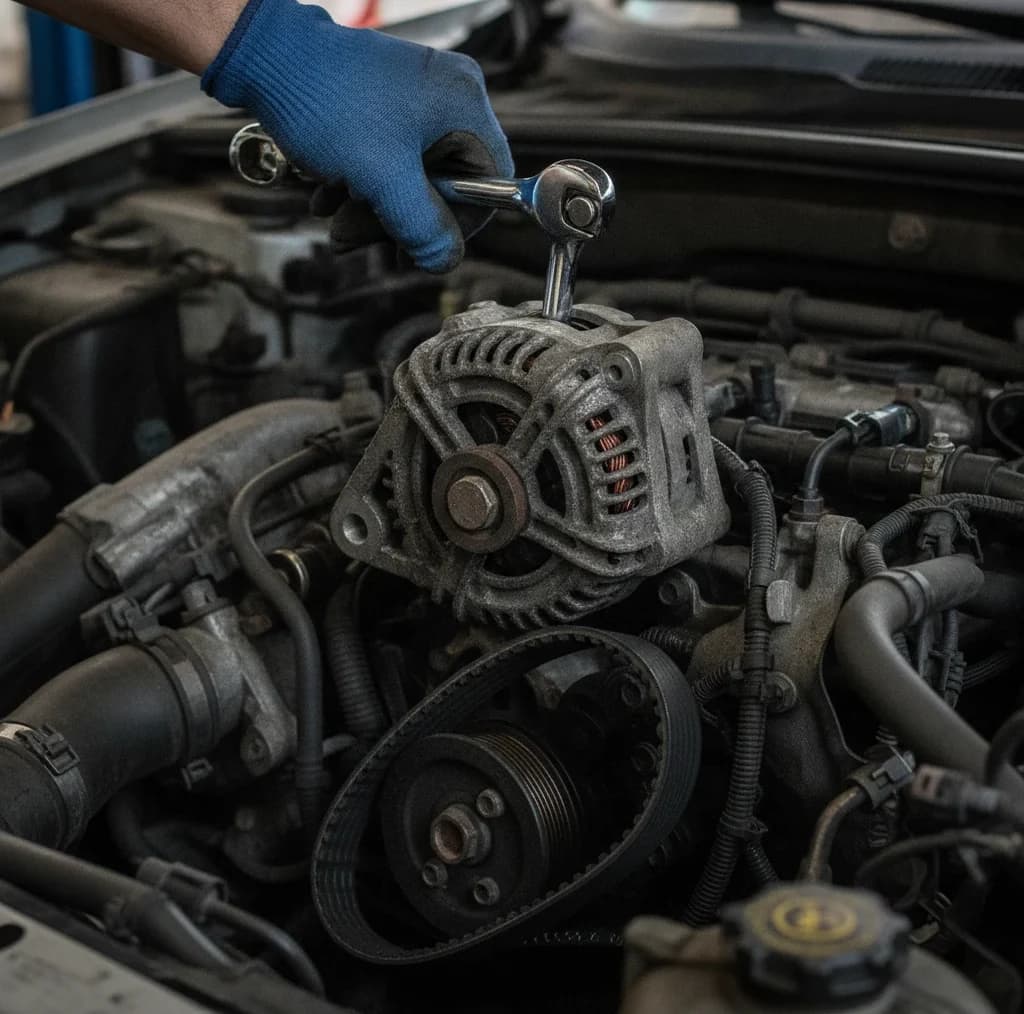
Key Takeaways
- Dealer: $450-$900. Shop: $300-$600. Reman over the counter: $150-$350. Yard: $25-$45
- Charging voltage should be 13.8-14.6 V with the engine running. Under 13 V is a failed alternator
- Most parts stores bench test free, which makes a used unit a checkable bet rather than a gamble
- Yard pricing is flat by part, so the saving is biggest on European and luxury cars
Cost by route
| Route | Part | Labor | Total |
|---|---|---|---|
| Dealer (new OEM) | $300-$650 | $150-$300 | $450-$900 |
| Independent shop (reman) | $150-$350 | $150-$280 | $300-$600 |
| Parts store reman, DIY | $150-$350 | Your labor | $150-$350 |
| Salvage yard, DIY | $25-$45 | Your labor | $25-$45 |
| Salvage part, shop fits it | $25-$45 | $150-$280 | $175-$325 |
Self-service yards charge by part category, not by vehicle. A BMW alternator and a Corolla alternator are the same price in the same aisle, which is why this is one of the better salvage buys on a European car.
Confirming it is the alternator
A multimeter settles this in two minutes and costs less than being wrong.
| Test | Good | Bad |
|---|---|---|
| Battery, engine off | 12.4-12.7 V | Under 12.2 V means a discharged or failing battery |
| Battery, engine running | 13.8-14.6 V | Under 13.0 V means not charging |
| Running with headlights and blower on | Stays above 13.0 V | Drops toward 12 V means insufficient output |
| Engine running, revved to 2000 rpm | Steady | Above 15 V means a failed regulator, which cooks batteries |
The overcharging case gets missed. If the regulator fails high, the battery boils off electrolyte and dies in a few weeks, and people replace the battery twice before checking voltage.
One more check before you buy anything: the belt and tensioner. A glazed belt slipping on the alternator pulley produces low voltage and a squeal, and that is a $30 belt rather than an alternator.
Testing a used alternator
Unlike a starter, you cannot fully test an alternator in the aisle, because it needs to be spun at speed under load. What you can do at the yard narrows the odds a lot, and the free bench test at a parts store finishes the job.
- Spin the pulley by hand. It should turn smoothly with no grinding and no side play. Rough bearings are the most common failure and they are obvious.
- Check the pulley type. Many modern alternators use a one-way clutch pulley. It should turn freely one way and drive the other. If it spins freely both directions the clutch is gone.
- Look at the case vents. Oil-soaked windings mean the donor had a leak dripping onto it. Walk away.
- Inspect the connector and the B+ stud. Green corrosion or a melted stud means it was running hot or wet.
- Take the bench test. Most parts stores will test a loose unit free. It catches diode and regulator faults you cannot see.
Interchange notes
Alternators are specified by mounting pattern, pulley type, connector, and output rating in amps. The first three have to match physically. The fourth has more room in it than people expect: a higher-output unit from the same family generally works, because the regulator only produces what the system asks for.
| Family | Commonly shares alternators across |
|---|---|
| GM LS truck | Silverado, Sierra, Tahoe, Suburban, Yukon, Escalade |
| Ford Modular 4.6/5.4 | F-150, Expedition, Crown Victoria, Town Car |
| Toyota 2GR-FE | Camry, Sienna, Highlander, RAV4, Avalon |
| Honda K/J series | Accord, CR-V, Odyssey, Pilot |
| VW/Audi EA888 | Golf, Jetta, Passat, A3, A4, Tiguan |
Two things break the interchange. Cars with stop-start or regenerative charging use a smart alternator the ECU controls over a data line, and a conventional unit will throw codes and undercharge. And some diesel and heavy-duty applications use a dual-pulley or larger-frame alternator that will not fit the standard bracket.
When the labor is the real cost
On most cars the alternator sits high on the front of the engine and comes out in under an hour. On some transverse V6 layouts it lives at the back of the block against the firewall, and reaching it means dropping the subframe or lifting the engine. Book time goes from one hour to five or six.
If that is your car, the $30 part barely matters. What matters is not doing the job twice, which is a good argument for spending the extra on a warrantied reman rather than a yard pull you cannot fully test.