
Key Takeaways
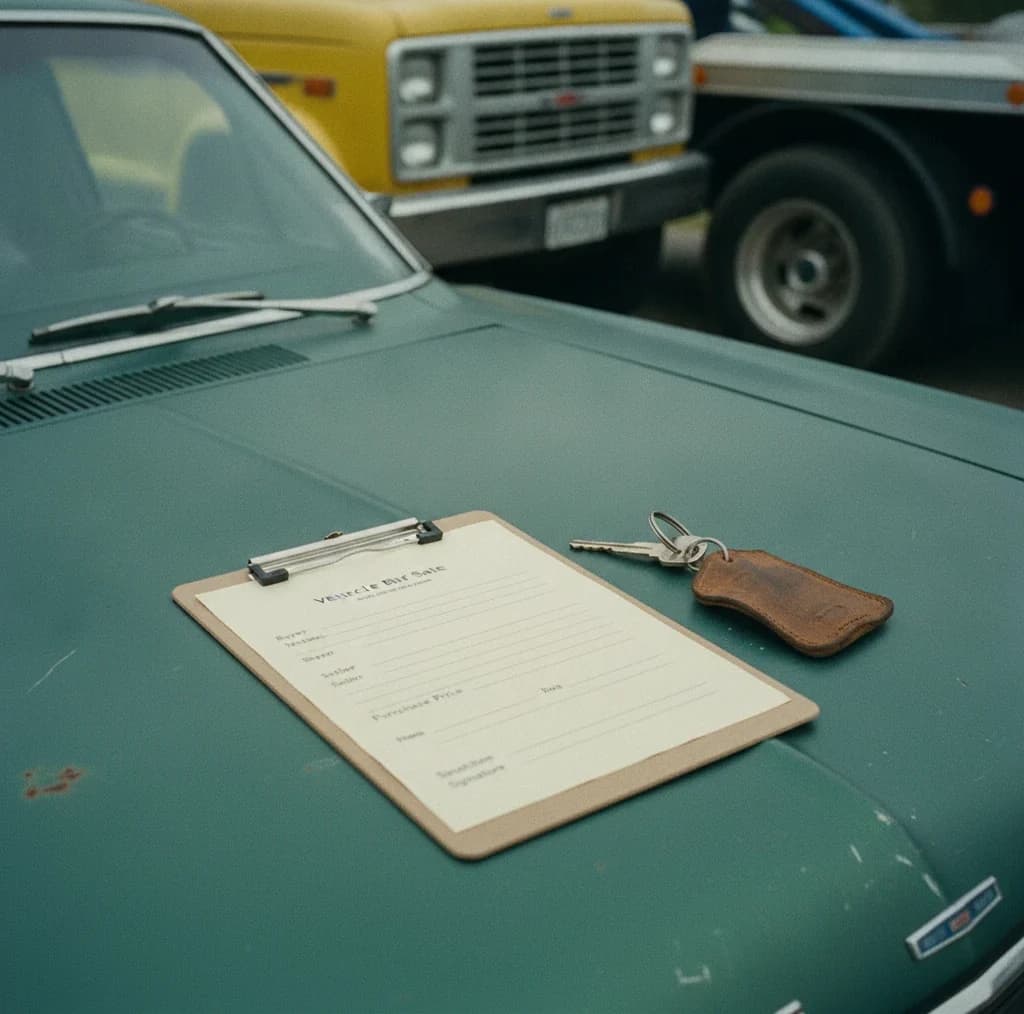
- A bill of sale needs both parties, the date, the price, the full VIN, an as-is clause, and signatures
- The release of liability filed with the DMV is what actually separates you from the car
- Take the plates off. They can collect tolls and tickets after the car is gone
- A duplicate title costs $15-$60 and usually raises what a yard pays by more than that
Why this matters more than it sounds
People treat scrapping a car as the end of a relationship. Legally it is a transfer, and until the state records that transfer, the car is still yours on paper.
What goes wrong is mundane and expensive. The car sits on a lot for three weeks with your plates on it and collects a parking citation. A tow operator takes it somewhere and the abandoned vehicle fee comes to the registered owner. The yard resells it running instead of crushing it, the buyer never registers it, and toll notices arrive at your address for the next year.
None of that is common. All of it is preventable with two documents and a screwdriver.
What the bill of sale must contain
| Element | Why it is there |
|---|---|
| Both parties, full legal names and addresses | Identifies who the car went to |
| Date of sale | Sets the moment liability transfers |
| Sale price | Tax reporting, and proof it was a sale not an abandonment |
| Year, make, model | Basic identification |
| Full 17-digit VIN | The only unambiguous identifier. Copy it from the dash plate, not the paperwork |
| Odometer reading | Federally required on most vehicles under 20 years old |
| As-is, no warranty clause | Prevents a claim that you misrepresented condition |
| Both signatures | Makes it a document rather than a note |
Several states publish their own form, and using it is easier than drafting one. Where a state offers a form, the DMV will accept that version without argument.
The title question
A yard buying a car for parts and a yard buying a car to resell face different rules, and that is why you get different answers from different places.
- You have the title. Sign it over exactly as the state directs. Do not leave the buyer field blank. An open title lets the car change hands repeatedly with your name as the last recorded owner.
- You lost the title. Order a duplicate. It is $15-$60 and one to three weeks, and most yards pay meaningfully more for a titled car, so it usually pays for itself.
- Your state allows titleless scrapping. Typically for older or low-value vehicles, using a junk certificate. You will normally need registration and photo ID proving you are the registered owner.
- There is still a lien. Nothing happens until the lender releases it. Pay off the balance and get the lien release letter first; no legitimate yard will touch it otherwise.
- The car was inherited. You will need the death certificate and either probate documents or a small-estate affidavit, depending on the state.
The step people skip
The release of liability, sometimes called a notice of transfer, is a separate filing with the DMV. The bill of sale is between you and the buyer. The release is between you and the state, and only one of those controls what happens when a citation is issued.
Most states want it within 5 to 10 days. Many take it online in a few minutes at no cost. Do it the same day you hand over the keys, and save the confirmation.
Before the truck arrives
- Take the plates. Return or transfer them per your state's rules.
- Empty it properly. Glovebox, center console, spare tire well, sun visors, under the seats, and the trunk. Registration documents and garage remotes are the two things people lose this way.
- Photograph the odometer and the VIN plate. Thirty seconds now, and it settles any later question about what you handed over.
- Cancel the insurance, but not before the car is gone. Cancel it early and you are uninsured on a vehicle still registered to you.
- Pull the toll transponder. It bills to your account from wherever the car ends up.
What the car is actually worth
Scrap value is mostly weight, and weight is mostly steel price, which moves. A typical sedan is 2,800-3,500 lbs and a full-size truck 5,000-6,000 lbs.
| Vehicle | Typical scrap-only offer | With a title and running |
|---|---|---|
| Compact sedan | $200-$400 | $400-$900 |
| Mid-size sedan | $250-$500 | $500-$1,200 |
| SUV | $300-$650 | $700-$1,600 |
| Full-size pickup | $400-$800 | $900-$2,200 |
Two things move the number more than the model does. An intact catalytic converter is worth a lot on its own, and an offer that seems high may quietly assume it is still there. And a car that drives onto the truck is worth more than one that gets winched, because it can be resold whole.
Call three yards. Quotes on the same car routinely differ by a couple of hundred dollars, and the call takes five minutes.