
Key Takeaways
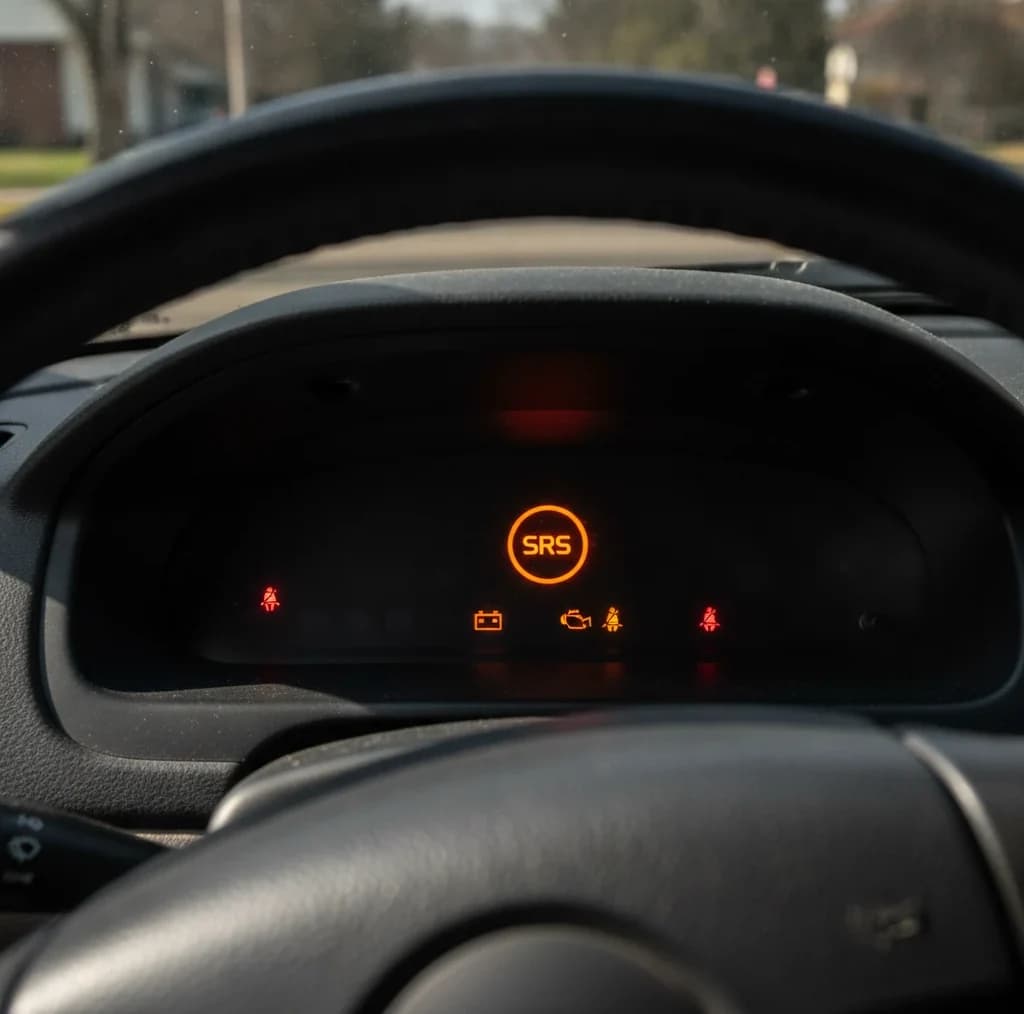
- The SRS light means the restraint system is disabled, not that a bulb is faulty
- Pretensioners fire in most deployments and are frequently missed in cheap rebuilds
- Clearing crash data without replacing deployed parts is not a repair
- Buying a rebuilt title car: get the SRS system verified before you buy, not after
What the light is telling you
The supplemental restraint system runs a self-test at every key-on. It checks each airbag circuit for correct resistance, checks the sensors, and checks its own stored state. If anything fails, it illuminates the light and disables deployment, because a system it cannot verify is more dangerous firing than not firing.
So the light is not a nuisance indicator. On a car showing it, the airbags will not deploy in a crash. That is the entire point of this article.
Why it stays on after a rebuild
When airbags deploy, the control module writes a permanent crash record. Most modules then refuse to return to a ready state, by design, because a module that has been through a deployment event cannot verify its own sensor calibration afterwards.
Rebuilds go wrong in a consistent set of ways:
- Pretensioners not replaced. Seat belt pretensioners are pyrotechnic and fire in most deployments. They are less visible than a burst airbag and get missed constantly.
- Module reset instead of replaced. The code clears, the light goes out, and nothing was actually repaired.
- Crash sensors reused. Front impact sensors mount in crush zones and are frequently damaged even when they still read.
- Clockspring skipped. The driver airbag circuit runs through it, and it is commonly damaged during steering column work.
- Wiring repaired with splices in a circuit whose resistance has to stay within tight limits.
- Wrong-generation parts fitted, which have the correct connector and incorrect deployment characteristics.
What a correct repair includes
| Component | Action | Why |
|---|---|---|
| Deployed airbags | Replace | Single-use pyrotechnic device |
| Seat belt pretensioners | Replace | Fire with the bags, single use |
| SRS control module | Replace or professionally restore | Holds locked crash record |
| Impact sensors | Inspect, replace if in the damage zone | Mounted where the impact happened |
| Clockspring | Replace if driver bag deployed | Carries the driver circuit |
| Wiring and connectors | Inspect the full path | Circuit resistance must stay in spec |
| Dashboard and trim | Replace as needed | Deployment tears mounting points |
The bill is why this gets skipped. A full, correct SRS restoration on a car with two deployed bags and two pretensioners can run $1,500-$4,000, which on a cheap rebuilt-title car is a large fraction of its value.
The reset services, plainly
You will find services that erase crash data from a module for $50-$150, sold as a fix for exactly this light.
Used as part of a proper repair, where deployed components have genuinely been replaced and the module is otherwise sound, module restoration has a legitimate place, and reputable rebuilders do it.
Used on its own, it produces a car whose warning light is off and whose airbags are not there or not connected. Anyone who buys that car reasonably assumes the restraint system works. It does not. There is no version of that which is acceptable, and in the event of an injury the liability follows the person who did it.
If someone offers to make your SRS light go away for a hundred dollars without replacing anything, they are offering to hide a fault, not fix one.
Buying a rebuilt title car
This is where most readers actually encounter the problem, and the checks are simple.
- Watch the SRS light at key-on. It should illuminate for a few seconds during the self-test, then go out. A light that never comes on at all is as suspicious as one that stays on: it may have been removed from the cluster.
- Scan for SRS codes with a tool that reads restraint modules. Many basic code readers do not.
- Look at the seat belts. Pull each one fully out and check it retracts smoothly and the webbing is undamaged. A fired pretensioner often leaves the belt locked or slack.
- Check the airbag covers for seam misalignment, mismatched texture or a dashboard that does not sit right.
- Ask for the repair documentation. A legitimate rebuild has parts invoices. No paperwork on a car with a deployment history is an answer in itself.
- Have it inspected by a shop that works on restraint systems, before purchase.
Where salvage parts do belong
To be clear about our own position: there is a great deal in a rebuild that used parts are ideal for. Doors, fenders, hoods, glass, lights, bumpers, interior trim, seats without pretensioners, and mechanical assemblies are all sensible salvage buys and are most of what a rebuild needs.
The restraint system is the exception. It is the one system in the car whose entire job happens in the fraction of a second when everything else has already failed.