
Key Takeaways
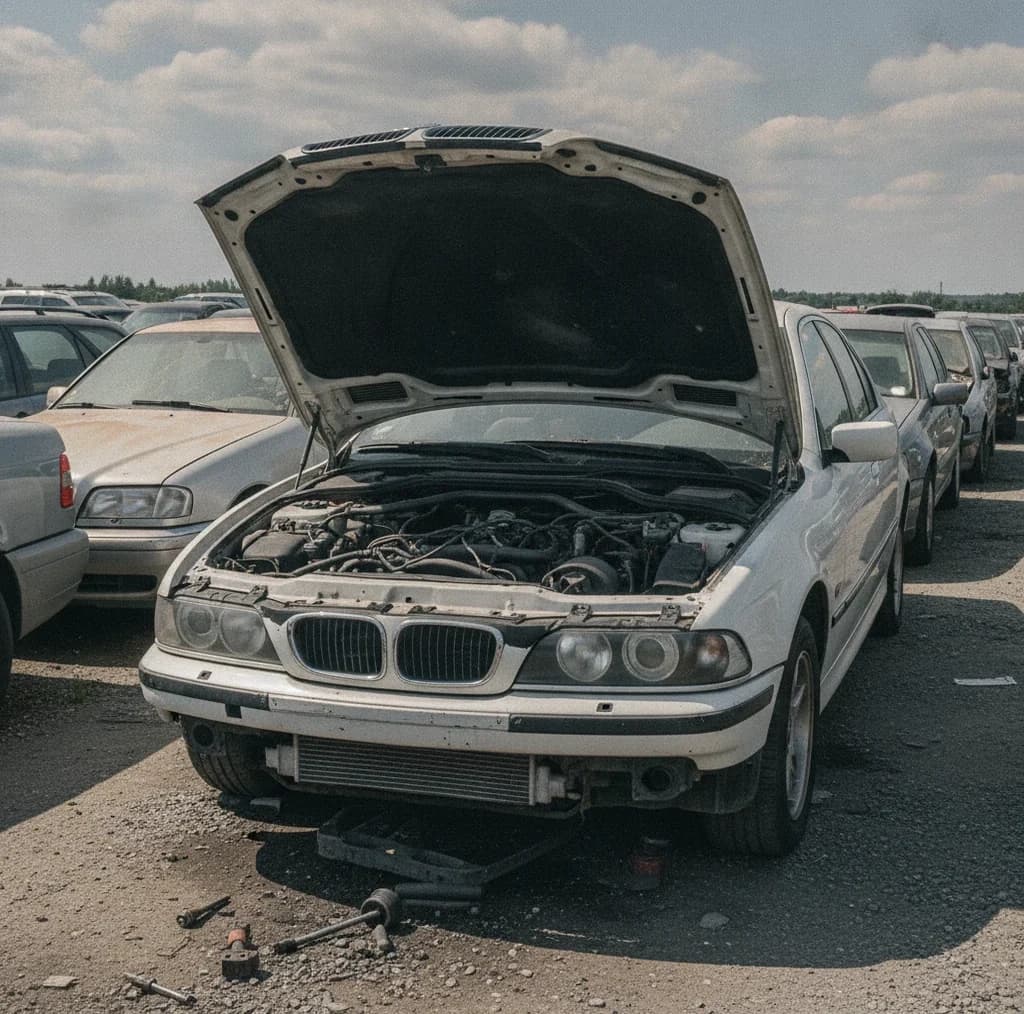
- Flat yard pricing plus expensive dealer parts makes BMW the biggest absolute saving in a yard
- Identify the chassis code, not the model name. That is what governs interchange
- Assume electronic modules need coding and budget for it
- Cooling system plastics and the VANOS and timing area are where these cars actually fail
Why the arithmetic favours BMW owners
Self-service yards price by part category. A door is the door price. An alternator is the alternator price. Nobody at the counter is checking what badge it came off.
New BMW parts cost several times the mainstream equivalent. So the same $40 yard price that saves a Civic owner $200 saves a 5 Series owner $700 on the same category of part.
That is the whole case, and it explains why the enthusiast community around older BMWs is so yard-oriented. Running one of these cars affordably past 120,000 miles is largely a matter of knowing where the yards are.
Identify the chassis
Model names are unreliable for parts. A 3 Series spans decades and multiple platforms. The chassis code is what governs interchange.
| Chassis | Model | Era |
|---|---|---|
| E46 | 3 Series | 1998-2006 |
| E9x | 3 Series | 2005-2013 |
| F3x | 3 Series | 2012-2019 |
| E39 | 5 Series | 1995-2003 |
| E60 | 5 Series | 2003-2010 |
| F10 | 5 Series | 2010-2017 |
| E53 / E70 | X5 | 1999-2006 / 2006-2013 |
| E83 / F25 | X3 | 2003-2010 / 2010-2017 |
Cars sharing a platform generation share far more than their names suggest. An E90 3 Series and an E70 X5 of the same era have real overlap in electronics and drivetrain ancillaries even though nothing about the bodies matches.
What interchanges well
- Engine ancillaries. Alternators, starters, power steering pumps and AC compressors within an engine family across models.
- Cooling components. Radiators, expansion tanks, thermostat housings, water pumps. These fail constantly, which makes them the most-bought BMW yard parts.
- Suspension. Control arms, links and bushings share widely within a chassis generation.
- Interior. Seats, trim, switchgear and door cards, subject to colour and trim matching.
- Electronics, with the coding caveat below.
- Glass and mirrors within the same model.
What does not interchange: body panels across models, anything with model-specific styling, and increasingly on later cars anything with a VIN-locked module.
Coding, which is the real constraint
BMW builds each car to an order and codes modules to match. Replacing a module usually means coding the replacement to your vehicle, which needs proper diagnostic software.
| Part | Coding needed? |
|---|---|
| Alternator, starter, pumps | No |
| Radiator, cooling parts | No |
| Suspension, brakes | No |
| Window and mirror motors | Usually no |
| Comfort and body modules | Yes |
| ABS or DSC module | Yes |
| Instrument cluster | Yes, and mileage considerations apply |
| Engine control module | Yes, often dealer-level |
Budget $100-$300 for coding at an independent BMW specialist. Many will code a part you supply, which keeps the arithmetic strongly in favour of a yard part on anything the dealer charges four figures for.
What actually fails on these cars
Knowing the failure patterns tells you what to look for and what to avoid buying used.
- Cooling system plastics. Expansion tanks, thermostat housings and radiator necks go brittle and crack, often around 80,000-100,000 miles. Buy these new. A used plastic cooling part is the same age as yours.
- Valve cover and oil filter housing gaskets. Leak on most of the six-cylinder engines. Gaskets are cheap and new.
- VANOS components. Rattling at cold start on many engines. Rebuild kits exist and are usually the better route.
- Timing chain guides on the N20 and N26 four-cylinders. A known issue and a reason to check service history on any donor.
- Suspension bushings, particularly front control arm bushings, which wear predictably.
- Window regulators, which fail on nearly every E-chassis car and are an excellent used buy.
The pattern: buy rubber and plastic wear items new, buy metal and electronics used.
At the yard
- Photograph the part number on your part first. BMW numbers are 7 or 11 digits and precise.
- Note the donor's chassis code from the VIN plate.
- Check production date on the door jamb sticker. BMW makes running changes and month of build sometimes matters.
- Take fasteners and brackets, which are expensive from the dealer and always the thing you are missing.
- Take the connector pigtail for electronic parts.
- Bring Torx and E-Torx sockets. Very little on these cars uses a hex head and yards do not lend tools.