
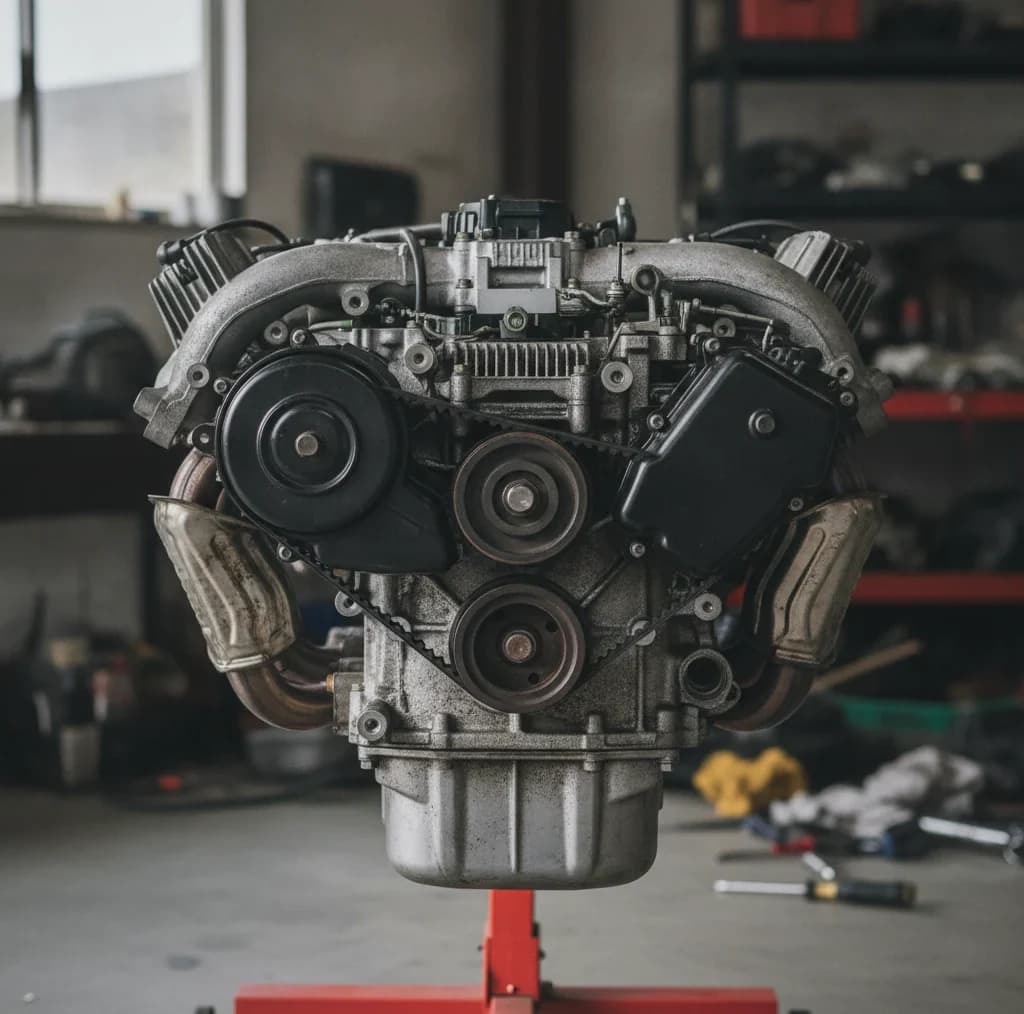
Key Takeaways
- EJ engines interchange broadly within the family. EJ to FB is not a swap, it is a project
- Timing belt on most EJ engines, timing chain on FB
- Check for external coolant staining at the head gasket seams before buying any EJ25
- Match SOHC to SOHC and DOHC to DOHC, and take the intake and harness with the engine
The two families
| Family | Years | Timing | Notes |
|---|---|---|---|
| EJ22 | 1990-2001 | Belt | 2.2L, considered the durable one |
| EJ25 DOHC | 1996-1999 | Belt | Early 2.5, internal gasket failures |
| EJ25 SOHC | 1999-2011 | Belt | The external head gasket leak reputation |
| EJ20/EJ25 turbo | 2002-2014 | Belt | WRX and STI, different gasket design |
| FB25 | 2011 on | Chain | Revised gaskets, longer stroke |
| FA20/FA24 turbo | 2012 on | Chain | Direct injection, different architecture again |
What interchanges within EJ
The EJ family shares a bellhousing pattern and mounting arrangement across most applications, which is why swaps between Impreza, Forester, Outback and Legacy are routine.
- Match SOHC to SOHC and DOHC to DOHC. They are not equivalent in accessory placement, valve cover clearance or wiring.
- Match the intake manifold to the engine and harness. Take both from the donor rather than mixing.
- Naturally aspirated and turbo are not casual swaps. Different pistons, oiling provisions and management.
- Check the crank sensor and reluctor arrangement, which changed within the EJ era and has to match the controller.
- Automatic and manual applications differ at the flexplate or flywheel and sometimes the crank register.
- Take the timing covers, which crack when removed and are frustrating to source.
The head gasket reputation, accurately
Subaru gets talked about as though every boxer engine fails. What actually happened is narrower.
The 1996-1999 EJ25 DOHC engines had internal gasket failures, which show as coolant and oil mixing, overheating and combustion gas in the coolant. That is the serious version.
The 1999-2011 EJ25 SOHC engines had a different and more common problem: an external leak where the gasket seals the outer edge of the block. It seeps coolant down the side of the engine, often smells sweet after a drive, and can run for a long time while slowly dropping the level. Unpleasant and expensive to fix, but not the catastrophic version.
Later multi-layer steel gasket designs and the FB family largely addressed it. If you are buying a used EJ25 SOHC, this is the specific thing to inspect, and it is visible: look for crusty pink or white residue down the sides of the block below the head joint.
Inspecting a used boxer engine
- Look down both sides of the block at the head-to-block seam for coolant staining.
- Check the oil cap and dipstick for milky residue.
- Look in the coolant reservoir for oil film.
- Inspect the timing belt on EJ engines. An intact belt with clean covers suggests the engine was running when scrapped.
- Turn it by hand two full revolutions at the crank pulley, feeling for even resistance.
- Check the timing belt service history if any paperwork survives. The interval is 105,000 miles and it is an interference engine.
- Note the donor's reason for scrapping. Front-end collision with a clean interior is the profile you want.
What to do before installing
On any EJ engine, replace the timing belt, tensioner, idlers and water pump before it goes in, regardless of what the belt looks like. All of it is behind the same labor, the kit is $150-$300, and the engine is out on a stand where the job is easy. Doing this later means pulling covers on an installed engine for no reason.
Replace the separator plate behind the flywheel while you are there. On many EJ engines it is a plastic part that fails and leaks oil, and it is inaccessible once the engine is mated to the transmission.
Then find out what killed the original engine. If yours overheated, check the radiator, fan and thermostat before running the replacement, or the new engine inherits the same fate.