
Key Takeaways
- Self-service: $300-$700 automatic, $150-$400 manual. Full-service: $600-$1,800 pulled for you
- You cannot test a yard transmission, so you are really judging the donor car
- Clean fluid and a collision-damaged front end is the donor profile you want
- Match the transmission code from the tag, not the model year
Decide whether to pull it yourself at all
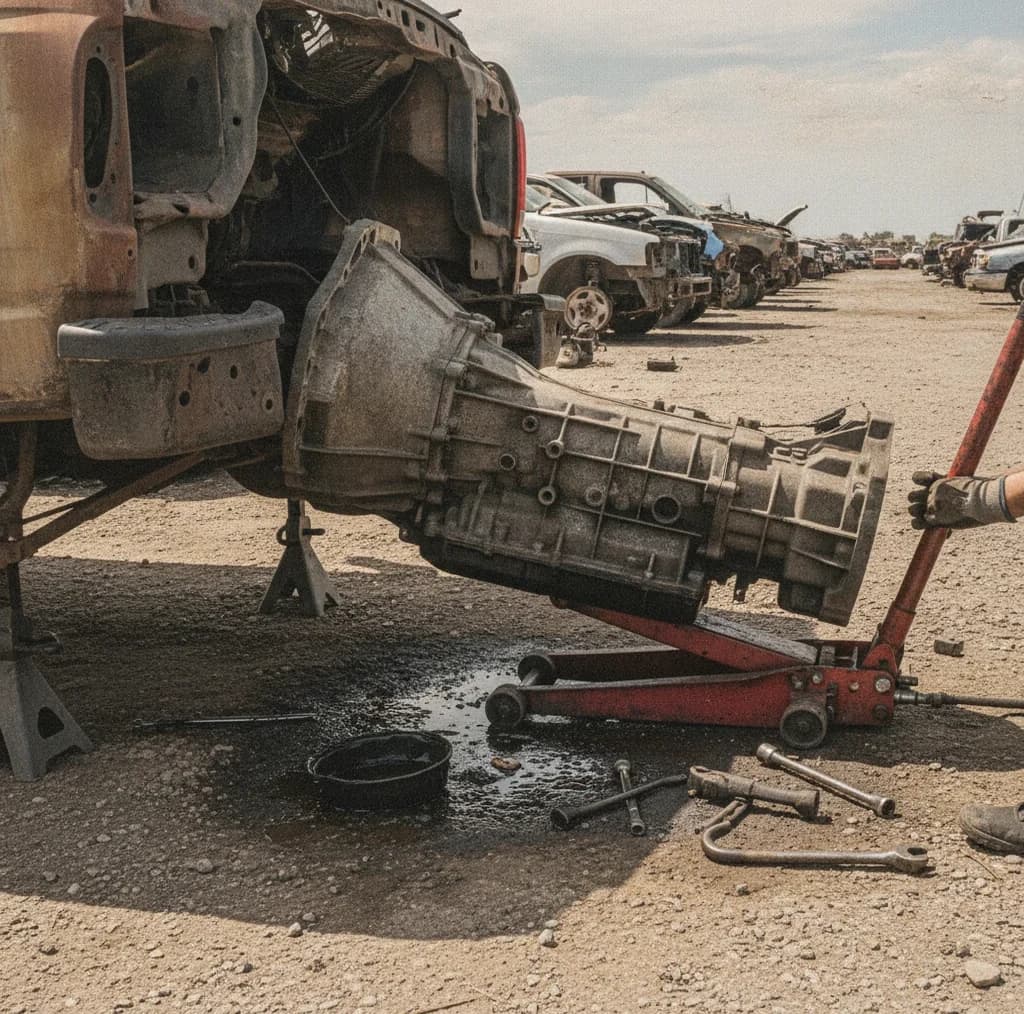
This is the largest, heaviest, most awkward thing most people ever remove in a gravel lot with no lift. An automatic transaxle is 150-250 lbs. A truck automatic can be 250-350 lbs. There is no cherry picker, no air, and no one to help you lift.
The saving is real: $300-$700 self-service against $600-$1,800 full-service. Whether that is worth a day and the risk of a wrong unit depends on your tools and your patience. On a rear-wheel-drive truck with room underneath, it is a reasonable job. On a transverse V6 where the transmission comes out with the subframe, most people should pay the full-service premium.
Identify the right unit first
Model year alone is not enough. Manufacturers run multiple transmissions in the same model year, and the difference is invisible from outside.
- Find the tag or stamped code on your own transmission and photograph it. This is the identity that matters.
- Match the engine. Bellhousing patterns and torque converters differ between engine families, and calibration differs even within one.
- Match the drivetrain. AWD, 4x4, and 2WD units have different tail housings and output arrangements.
- Match the final drive ratio on transaxles. The wrong ratio will drive but the speedometer, shift points, and fuel economy will all be off.
- Check for mid-year revisions. Valve body and calibration changes are common and are not always flagged in catalogues.
Most chains publish searchable inventory, so identify candidate donors from home rather than walking rows.
Reading the donor
You cannot road test it. What you can do is work out why the car is in the yard, which tells you most of what you need.
| Observation | What it suggests |
|---|---|
| Front-end collision, clean interior | Best case. Drivetrain was probably healthy |
| Fluid bright red, no smell | Serviced recently, good sign |
| Fluid dark brown, burnt smell | Overheated clutches. Walk away |
| Metal flakes on the dipstick | Internal failure. Walk away |
| Milky pink fluid | Coolant intrusion from a failed radiator cooler. Walk away |
| Engine already pulled, transmission left | Someone judged the engine worth more. Neutral signal |
| Rust through the floor, high mileage | Scrapped for age. Transmission is as old as the car |
| Water line inside the door | Flood car. Avoid entirely |
Two mechanical checks before you commit. Rock the input shaft or torque converter to feel for excessive play, and turn the output flange by hand; it should turn with steady resistance, not catch or grind.
The pull
Order varies by car, but the sequence is consistent.
- Disconnect the battery if it is still in the car, then drain the fluid into a pan. Yards care about spills.
- Remove the airbox and battery tray for access on transverse layouts.
- Disconnect linkage, wiring, and cooler lines. Photograph every connector before it comes off.
- Support the engine. On transverse layouts the transmission is holding one side of the engine. A support bar or a jack with a plank is not optional.
- Break the axle nuts before lifting on FWD cars. They are torqued to 200 lb-ft and will not move once the wheels are off the ground.
- Remove the driveshaft or axles. Expect the inner joints to fight you.
- Unbolt the torque converter from the flexplate through the inspection cover, rotating the crank to reach each bolt. Missing this bends the flexplate.
- Support the transmission, then remove the bellhousing bolts. Leave two loosely fitted until the weight is fully supported.
- Separate and lower. Keep the converter pushed into the pump or it will slide out and dump fluid on you.
What to take besides the transmission
- The torque converter, kept vertical so it does not drain
- The bellhousing dust cover and every bolt
- The shift linkage or cable, and its bushings
- The transmission mount
- Both cooler lines and their fittings
- The wiring harness pigtail if it unplugs at the module
- The dipstick and filler tube, which are model-specific and easy to forget
Before you install it
Drain the converter and refill with the correct fluid, replace the front pump seal and the filter, and prime the converter by hand before mating. A dry start puts the pump under load before it has fluid, and that is the fastest way to kill a transmission that was fine when you pulled it.
Then find out what killed the original. If the fluid in yours came out with metal in it, that debris is in the cooler lines and the radiator cooler. Flush both or the new unit inherits the same problem within weeks.