
Key Takeaways
- Four generations: YJ 1987-1995, TJ 1997-2006, JK 2007-2018, JL 2018 on
- Body panels, tops, doors and interiors interchange within a generation, rarely across
- Axles and transfer cases are the parts that genuinely cross generations
- Check for lift, off-road abuse and rust at the frame before buying anything structural
The generations
| Gen | Years | Engines | Front suspension | Notes |
|---|---|---|---|---|
| YJ | 1987-1995 | 2.5 I4, 4.2 I6, 4.0 I6 | Leaf | Square headlights, leaf sprung both ends |
| TJ | 1997-2006 | 2.4 I4, 4.0 I6 | Coil | Coil conversion, LJ Unlimited from 2004 |
| JK | 2007-2018 | 3.8 V6, 3.6 Pentastar | Coil | Wider body, 4-door introduced |
| JL | 2018 on | 3.6, 2.0 turbo, 3.0 diesel | Coil | Aluminum panels, complex electronics |
Axles, the parts that really travel
Axles are why people walk Jeep rows. The Dana 44 is the upgrade everyone wants, and it appears in Rubicon trims, some full-size applications and various other Chrysler products.
- Dana 30 front is the base axle across YJ, TJ and JK. Adequate stock, marginal with large tires.
- Dana 35 rear is the weak point and the reason for most rear axle swaps.
- Dana 44 front and rear came on Rubicon trims and is the common target. TJ Rubicon 44s are notably sought after.
- Width matters more than fitment. Axles from other vehicles often bolt in but change track width, which affects tire clearance and steering geometry.
- Gear ratio has to match front to rear. Mixing ratios damages the transfer case. Check the tag or count the ratio before buying.
- Spring perch position differs between leaf and coil generations and usually needs cutting and rewelding.
Engines and transmissions
The 4.0 inline six is the engine the aftermarket loves, fitted across YJ, TJ and Cherokee applications. It shares its bellhousing with the 2.5 four within those eras, which makes the four-to-six swap straightforward by swap standards: engine, harness, computer, radiator and often a stronger transmission.
The 3.8 V6 in early JKs is generally considered the weakest engine of the four generations, and swapping it for a 3.6 Pentastar from a later JK is common. That swap needs the matching transmission, harness and computer, and the electronics are the hard part rather than the mechanical fit.
Transfer cases interchange more freely than transmissions. The NP231 appears across YJ, TJ and many Cherokees, and the NP241 in heavier applications. Match the input spline count and the transmission adapter.
Body, and why it does not cross generations
Every generation changed the tub, the windshield frame and the body mounts. A JK is meaningfully wider than a TJ. So hardtops, soft top frames, doors, fenders, hoods and windshields are generation-specific.
Within a generation, they interchange freely, and this is one of the better reasons to visit a yard as a Jeep owner. A hardtop is $1,500-$3,000 new and a few hundred used. Doors, tailgates and fender flares are similar. Wranglers get modified constantly, so yards accumulate the take-off parts people replaced with aftermarket versions.
What to check before buying anything structural
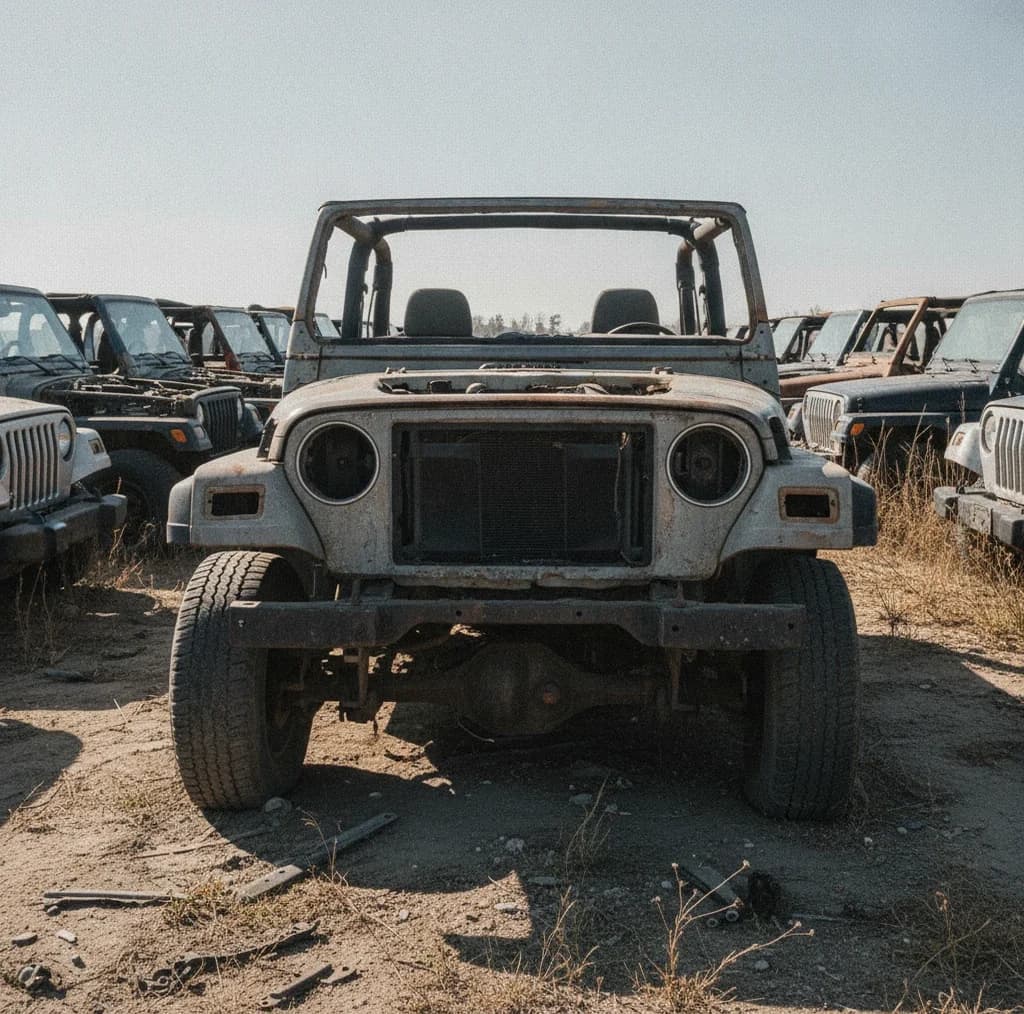
Wranglers get used the way they were designed to be used, and it shows.
- Frame rust, especially at the rear spring hangers and the skid plate mounts on TJs. Poke it, do not just look.
- Evidence of a lift, which means the axles and steering worked at angles they were not designed for.
- Water damage inside. Soft tops leak, and a Jeep interior that has been wet repeatedly has corroded connectors throughout.
- Bent axle tubes, checked by sighting along them. Common on heavily wheeled trucks.
- Aftermarket wiring. Light bars and winches are often wired badly, and that damage lives in the harness you are about to buy.
- Missing skid plates, which suggests the underside took hits.
JL and the electronics problem
The JL is the generation where casual parts swapping mostly stops. Modules are VIN-coded, the body controller manages functions that were mechanical before, and many replacement parts need dealer-level programming to work.
Mechanical parts, body panels and glass still interchange within the generation. Anything with a connector on it needs checking first, because a part that bolts on and does nothing is the common outcome.