
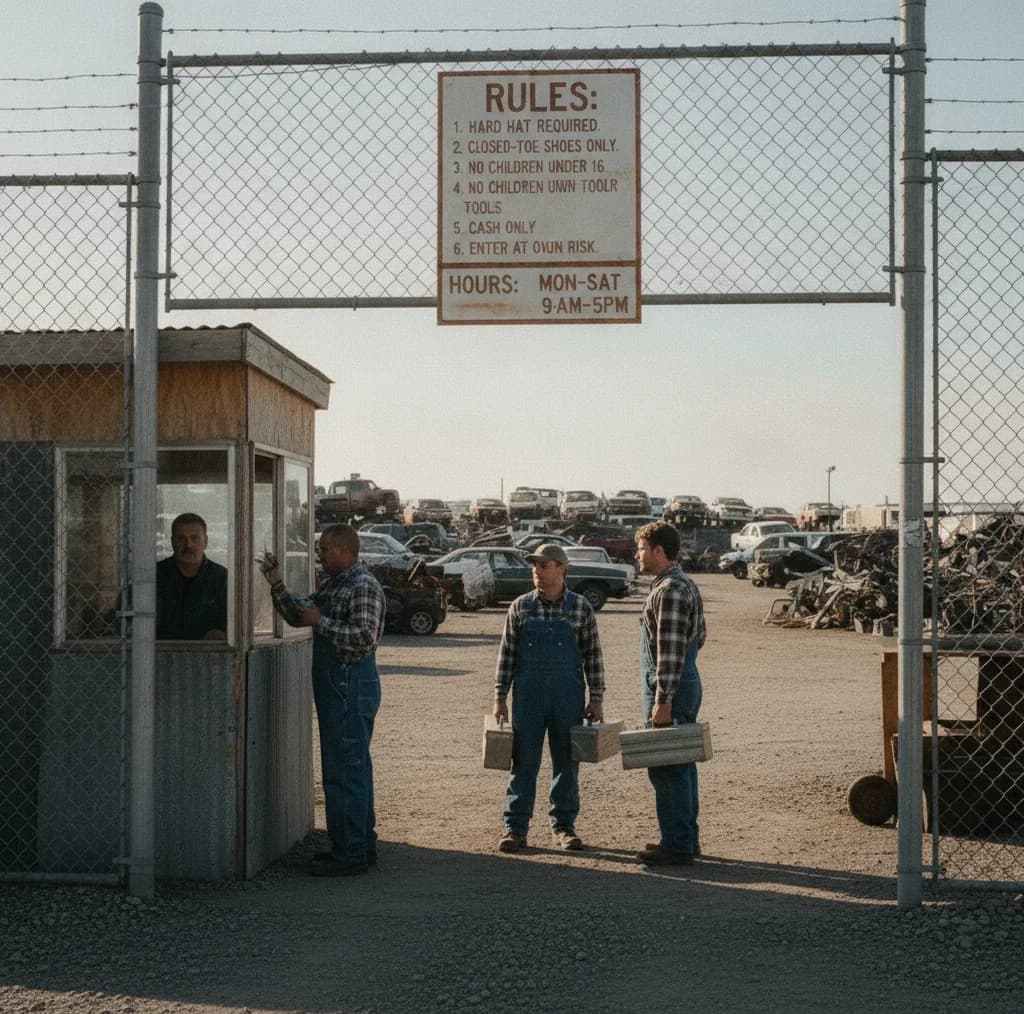
Key Takeaways
- Pay a small entry fee, pull what you want, pay at the exit. Leave anything that turns out wrong
- Battery tools yes. Torches, grinders, and cutting wheels no, at every yard
- Most yards ban personal jacks. Use the supports they provide
- Closed-toe shoes, long sleeves, gloves, and eye protection are the practical minimum
How a self-service visit works
If you have only been to full-service yards where someone hands you a part over a counter, the self-service model is different in a way that suits some jobs very well.
You pay $2-$5 at the gate, sign a waiver, and walk in with your tools. The cars sit in rows, usually organised by make, drained of fluids and with batteries removed. You find your donor, remove what you need, and carry it to the checkout, where it is priced from a posted list. Anything you decide against, you leave.
That last point is the real advantage. You can pull a part, discover the mounting ear is cracked, and walk away having spent the entry fee.
Rules that are actually about safety
Yard rules read like liability boilerplate. Most are not.
- No personal jacks. A yard car has no fluids, often no engine, sometimes no suspension on one corner. Weight distribution is not what you would predict, and unibodies weakened by removed structure fold in ways an intact car does not. Yards set cars on their own supports for this reason.
- No torches, grinders, or cutting wheels. Cars still hold fuel residue, and there are hundreds of them in rows. This rule is universal and yards will remove you for breaking it.
- Nobody under 16. Insurance, and sharp metal at head height for a child.
- Closed-toe shoes. The ground is gravel, broken glass, and dropped bolts.
- No draining fuel tanks. Environmental rules and fire risk. Yards handle this themselves.
- No climbing on or under stacked vehicles. Stacks are stable until they are not.
The things that actually injure people in yards are unremarkable: a hood falling because the strut has no gas left, a spring under tension released without a compressor, cuts from cut sheet metal edges, and burns from residual coolant in a system that is still pressurised on a hot day.
What to wear and bring
Long sleeves and long trousers even in summer, because sheet metal edges are sharp and you will be reaching into places you cannot see. Gloves that still let you feel a bolt. Eye protection, particularly for anything overhead — rust falls straight down. Boots, not trainers.
For tools: a full metric and SAE socket set with extensions and a breaker bar, a battery impact wrench, screwdrivers and trim removal tools, pliers and vise grips, penetrating oil applied before you start rather than when you are stuck, a headlamp for interiors, and a wagon or hand truck. Cash, because some yards still do not take cards in the rows.
The unwritten rules
These are what make you a regular rather than a nuisance.
- Do not strip what you do not need. Cutting a harness to reach one connector ruins that harness for the next twenty people.
- Put panels back roughly where they were. Leaving a door card in the mud means the next person cannot assess the car.
- Do not take bolts you are not using. Hardware is what people struggle to find.
- Leave the car supported as you found it.
- If someone is working a car, ask before starting on the other side. Two people on one vehicle is fine, unannounced is not.
- Clean up spills and tell staff about anything significant. Yards operate under environmental permits, and a reported spill is routine while an unreported one is a problem.
- Do not hide parts for later. Stashing a part in another car to come back tomorrow is the one that genuinely annoys everyone.
Timing your visit
Newly set rows still have their common parts. A car that has been in the yard three weeks has lost its alternator, starter, both mirrors, and usually the battery tray. Most chains publish set dates, and sorting by them is the difference between a productive trip and a walk.
Weekday mornings are quieter and the popular cars have not been picked over that weekend. Sale weekends are cheaper and considerably more crowded; if you know exactly what you want, that trade is fine, and if you are browsing, it is not.
Weather matters more than you would think. Rain turns the rows to mud and makes everything slower. Heat makes a black interior unworkable by midday. Cold makes seized bolts worse and your hands useless.
At the counter
Prices come off a posted list and are generally not negotiable at self-service yards, though damaged parts and multi-part purchases are worth asking about. Expect a core charge on alternators, starters, and calipers, refunded when you return the old one, so bring it with you.
Keep the receipt and leave the yard tag attached to the part until it is fitted and working. Every warranty depends on those two matching, and most yards offer 30-90 days with an extension available for a small premium. On an engine or transmission, buy the extension.