
Key Takeaways
- Entry fee is $2-$4 at most self-service yards. Bring your own tools — yards don't lend them
- Search the yard's inventory online before you go so you don't waste a trip
- Look up your part's interchange number to know which years and models share the same part
- Average savings: 60-75% compared to new OEM parts, 40-60% compared to aftermarket
What Is a Self-Service Junkyard?
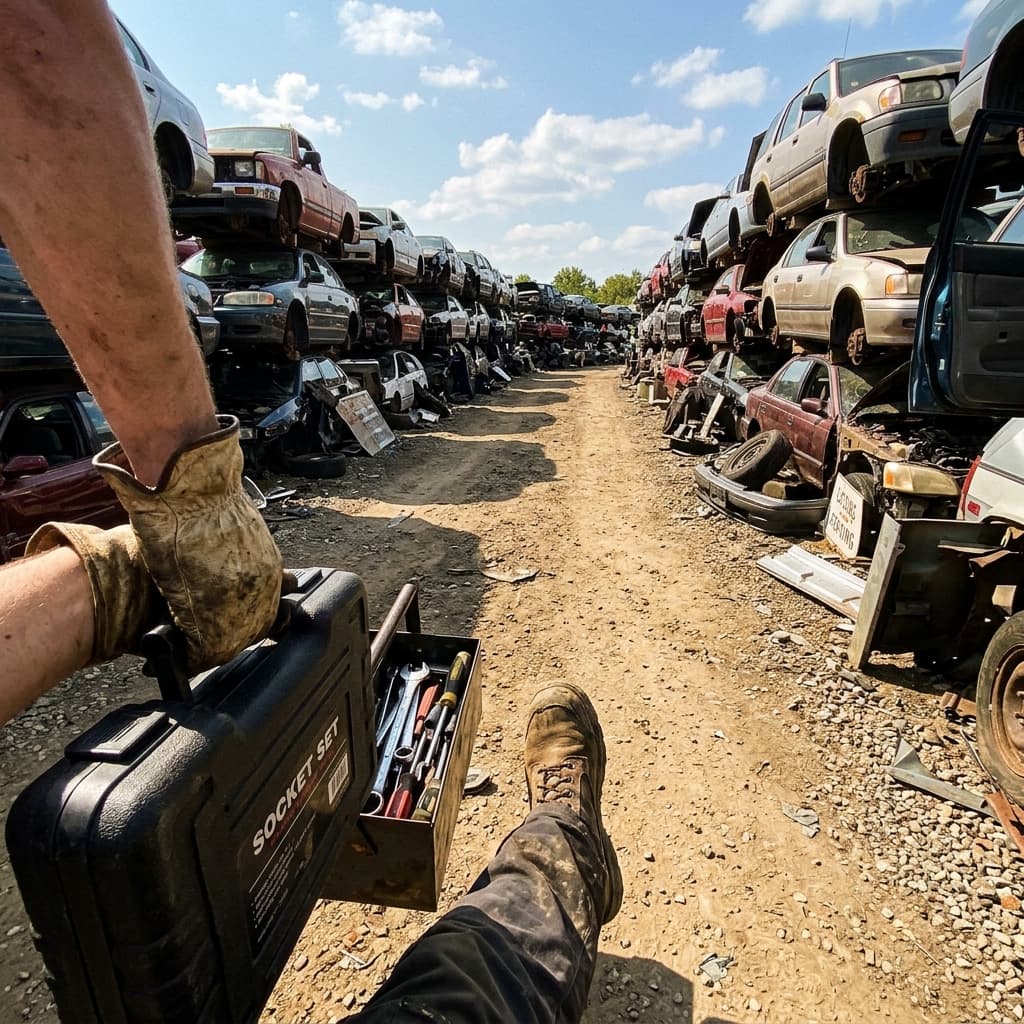
A self-service junkyard is a salvage yard where you walk out to the lot, find the vehicle you need parts from, and remove the parts yourself using your own tools. You pay a small entry fee ($2-$4) and then pay for each part based on a flat-rate price list at checkout.
The biggest self-service chains in the U.S. are LKQ Pick Your Part (70+ locations), Pick-n-Pull (80+ locations), and Pull-A-Part (25+ locations). There are also thousands of independent self-service yards.
The tradeoff is simple: you do the work, you get the lowest prices. A starter motor costs $25-$40 here versus $200-$400 new. An alternator runs $25-$45 versus $250-$500 new.
The Complete Tool List
Don't show up empty-handed. Here's what you actually need, broken down by experience level:
| Tool | Why You Need It | Cost |
|---|---|---|
| Socket set (metric + SAE) | Removes 80% of bolts on any car | $25-$60 |
| Combination wrench set | For tight spaces where sockets won't fit | $15-$30 |
| Phillips + flathead screwdrivers | Interior panels, trim clips, electrical | $5-$15 |
| Pliers (needle-nose + channel-lock) | Hose clamps, wiring connectors | $10-$20 |
| Flashlight (headlamp preferred) | Cars are packed tight, it gets dark fast | $10-$20 |
| Work gloves | Sharp edges everywhere | $5-$10 |
| Wire cutters | Cutting zip ties and wiring harnesses | $5-$10 |
Optional but worth it: Battery-powered impact gun ($40-$80 at Harbor Freight), breaker bar for stuck bolts, penetrating oil (PB Blaster), and a small floor jack if you're pulling suspension parts.
Before You Go: The 5-Minute Prep That Saves Hours
The number one mistake first-timers make is showing up without knowing what they need. Five minutes of research before you leave the house will save you hours of wandering.
- Search the yard's inventory — Go to JunkyardInventory.com and check if the yard has your vehicle in stock. No point driving 30 minutes if they don't have your car.
- Look up the interchange number — This tells you which other years and models use the same part. A 2015 Honda Civic alternator might be identical to the one on a 2012-2016 Civic. That triples your chances of finding one.
- Take a photo of the part on your car — Before you leave home, photograph the part you're replacing. You'll want a reference when you're standing in front of a donor car trying to remember which connector goes where.
- Write down the part number — If the part has a visible OEM number, write it down. This is especially important for electrical components, ECUs, and sensors.
- Bring cash — Some smaller yards are cash-only. Major chains accept credit cards, but bring $50-$100 in cash just in case.
What to Expect When You Arrive
Here's the typical self-service junkyard experience, start to finish:
Check-in (5 minutes): You'll sign a liability waiver and pay the entry fee. The counter staff can tell you which row your vehicle type is in — most yards organize cars by make (all Hondas in one area, all Fords in another).
Finding your car (5-30 minutes): Walk the rows until you find the right vehicle. If the yard has multiple copies of your car, check all of them. One might have the part in better condition than another.
Inspecting the part (5-10 minutes): Before you start unbolting, check the part's condition. Look for cracks, corrosion, broken mounting tabs, and moisture damage. On electrical parts, check the connector pins for corrosion. On body panels, look for rust from the back side.
Pulling the part (15-60 minutes): This is where your tools matter. Work methodically. Take photos as you go so you remember the reassembly sequence. Put all bolts and clips in your pocket or a ziplock bag.
Checkout (5 minutes): Bring the part to the counter. Staff will look up the price on their flat-rate list and ring you up. Some parts need to be checked against a restricted list (catalytic converters, airbags) — the staff will handle this.
Self-Service Junkyard Pricing
Prices are standardized across most self-service chains. Here are typical rates:
| Part | Typical Price |
|---|---|
| Alternator | $25-$45 |
| Starter | $25-$40 |
| Window motor/regulator | $15-$25 |
| Side mirror (power) | $15-$25 |
| Headlight assembly | $20-$40 |
| Door (complete) | $75-$150 |
| Seat (each) | $30-$60 |
| Wheel (each) | $25-$50 |
| Radiator | $25-$45 |
| A/C compressor | $25-$40 |
Most yards have the full price list posted at the entrance and on their website. Some chains (LKQ Pick Your Part) run color-tag sales where all parts from cars with a specific tag color are 50% off.
15 Tips from 12 Years of Pulling Parts
- Go early. The best inventory gets picked first, especially after the yard adds fresh cars.
- Check when new cars get added. Most yards update inventory weekly. Ask the staff which day new cars hit the lot.
- Bring a friend for heavy parts. Doors, seats, and dashboards are awkward to carry solo.
- Spray stuck bolts with penetrating oil and come back to them in 10 minutes.
- Check multiple donor cars. Part condition varies wildly between the same model.
- Pull extra parts while you're there. If your alternator is failing, grab a spare for $25.
- Don't forget the small stuff — grab clips, trim fasteners, and connectors. These are cheap and hard to find at auto parts stores.
- Bring a cooler with water and snacks. You'll be out there for hours.
- Wear sunscreen. Junkyard lots have zero shade.
- Check your phone signal before walking deep into the yard. Some yards are in dead zones.
- Take photos of the VIN plate on the donor car. If the part doesn't fit, the VIN helps figure out why.
- Watch for color-tag sale days. LKQ and Pick-n-Pull run weekly sales where tagged cars are 50% off.
- If the part looks too good to be true (brand-new alternator on a 2015 car), it might be an aftermarket part someone swapped in. Check for OEM stampings.
- Bring ziplock bags for bolts and small hardware. You'll forget which bolt goes where otherwise.
- If you can't get a bolt off, don't force it. You can break the casting on the donor car, which means you need to find another car to pull from.
Find a Self-Service Junkyard Near You
Search our inventory to find vehicles at 200+ salvage yards near you. We cover LKQ Pick Your Part, Pick-n-Pull, Pull-A-Part, and more.
Already found your yard? Check out our complete guide to finding junkyards in every state for location-specific tips and chain comparisons.