
Key Takeaways
- Drain and fill: $80-$250. Full flush: $150-$400. Dealer adds roughly 40 percent
- A drain and fill replaces 40-50 percent of the fluid. A flush replaces almost all of it
- Lifetime fill usually means the life of the warranty, not the life of the car
- Use the exact fluid spec. The wrong fluid in a CVT ruins it, and no amount of changing fixes that
What each service costs
| Service | What it does | Independent shop | Dealer |
|---|---|---|---|
| Drain and fill | Empties the pan, 40-50 percent of total fluid | $80-$250 | $150-$350 |
| Drain, fill, filter, gasket | Adds filter and pan gasket | $150-$350 | $250-$500 |
| Machine flush | Exchanges nearly all fluid through the cooler lines | $150-$400 | $250-$500 |
| DIY drain and fill | Your driveway, 4-6 quarts | $40-$120 | — |
Fluid is most of the parts cost. Generic multi-vehicle ATF runs $8-$12 a quart, manufacturer-specific fluid $12-$20. A CVT or a dual-clutch can run higher, and those are the ones where substituting is a bad idea.
Drain and fill versus flush
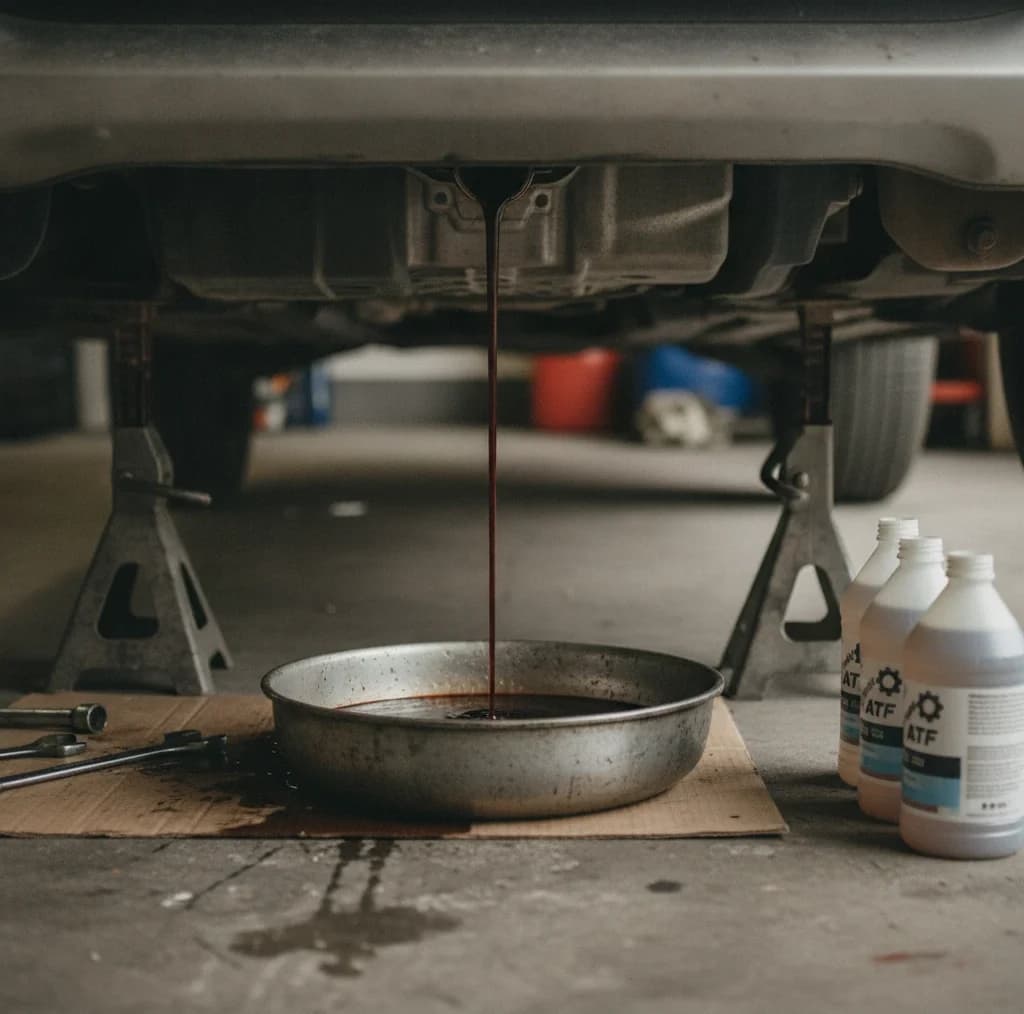
A drain and fill drops the pan or opens a drain plug and lets out what is sitting there. The torque converter and cooler lines hold the rest, so you get roughly half. A machine flush hooks into the cooler lines and pushes new fluid through until what comes out runs clean.
On a car that has been serviced regularly, the flush is straightforwardly better. You end up with almost all new fluid for maybe $100 more.
The argument is about the other case: 140,000 miles, original fluid, dark and smelling burnt. You will hear that a flush kills these. What actually happens is more specific than that. Worn clutch material and varnish have been building up, and some of it is filling clearance in a valve body that is out of spec. New fluid with fresh detergent carries that away, clearances open up, and slipping that was being masked shows up within a few hundred miles.
The transmission was already worn out. The flush changed when you found out. That said, if you are trying to get another two years out of a car, staged drain and fills — one now, another in 3,000 miles, a third after that — dilute the old fluid gradually and are the lower-risk path.
Getting the fluid spec right
This matters more than the service interval. Automatic transmission fluid is not one product, and the friction modifiers differ by manufacturer.
| Family | Spec | Notes |
|---|---|---|
| Ford 6R/10R | Mercon LV / ULV | ULV is required on the 10R80. Using LV brings back the shudder |
| GM 6L/8L | Dexron VI | Backward compatible with Dexron III applications |
| Toyota | WS | Sealed, no dipstick. Level is set by temperature at a check plug |
| Honda | DW-1 | Honda automatics are notably intolerant of generic ATF |
| Nissan/Subaru CVT | NS-3 / CVTF | Belt and pulley friction depends on it. Do not substitute |
Multi-vehicle ATF that lists a dozen specs on the bottle is fine on older domestic units and a gamble on anything modern. The saving is a few dollars a quart against a transmission.
The sealed transmission problem
Plenty of modern transmissions have no dipstick. Checking and filling means a level plug on the side of the case, and the level is only correct within a narrow fluid temperature window, read with a scan tool.
This is why quick-lube shops sometimes get it wrong. Fill cold and it reads full, then the fluid expands and pushes past the seals. Underfill and it starves at speed. If your car uses a check plug, the shop needs a scan tool for the job, and it is fair to ask whether they have one.
When the fluid is not the problem
Fluid maintenance keeps a working transmission working. It does not fix one that has already failed, and it is worth knowing which side you are on before spending anything.
- Delayed engagement — several seconds between shifting into drive and the car moving. Usually internal wear or a failing pump.
- Slipping under load — revs climb going uphill without accelerating. Worn clutch packs.
- Harsh or repeated shifting — often a valve body or solenoid, sometimes fixable on its own.
- Shudder at light throttle around 40 mph — torque converter clutch. On Ford 10R80 applications this is frequently the fluid, which is the exception worth trying.
- Metal on the pan magnet — fine paste is normal, chips and flakes are not. Flakes mean the fluid change is money spent on a transmission that is going to be replaced.
If it is the last one, the numbers change completely. A used transmission from a salvage yard is $300-$1,200 against $3,000-$6,000 for a new unit, and at that point the fluid service is a rounding error on a decision you have already made.