
Key Takeaways
- Shop: $250-$600 per door. New part $80-$300. Used $20-$45
- You can test a used regulator in the donor door before pulling it, which few parts allow
- Motor running with no glass movement means the mechanism, not the motor
- Buy spare door card clips before you start. You will break some
Why this is the buy we recommend most
Most used parts involve a judgement call. This one does not, because you can operate it before you buy it.
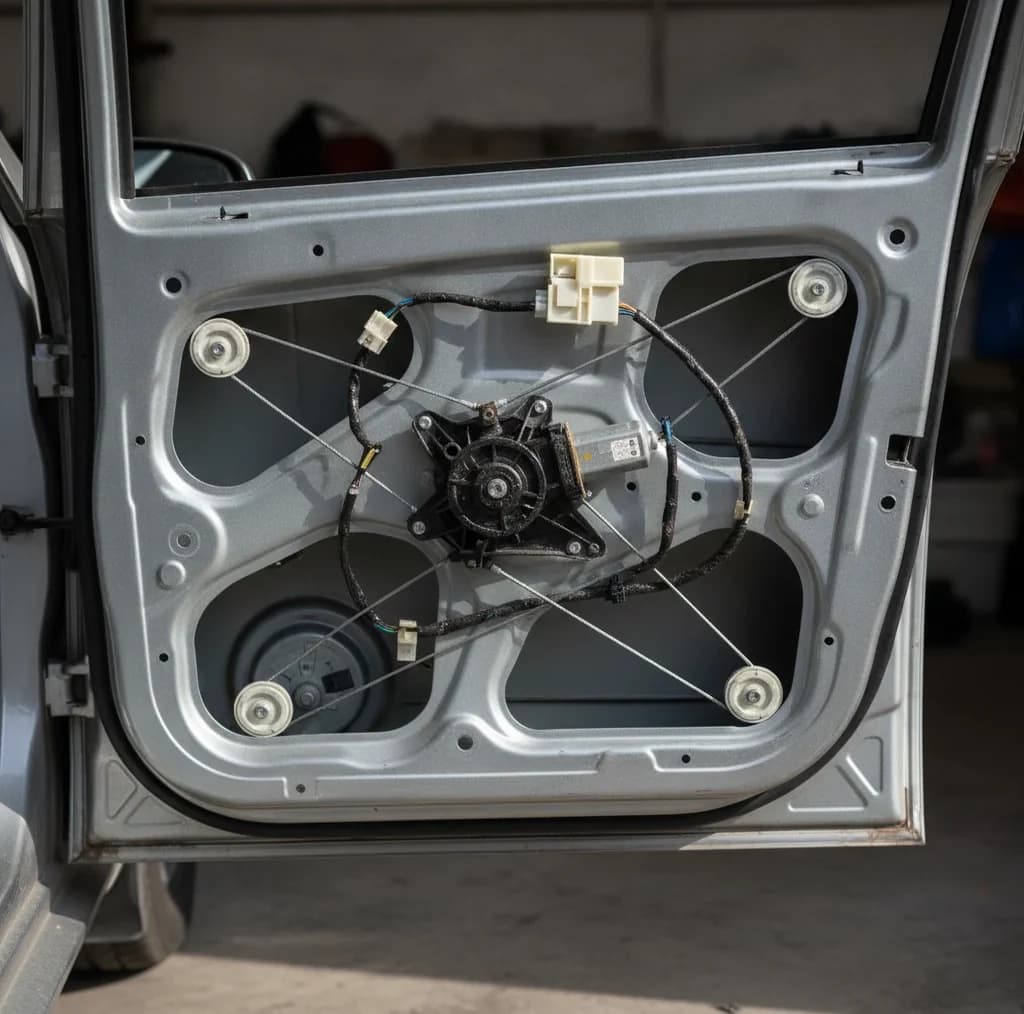
Yard cars have no battery, but the door module and motor will run off a jump pack applied to the motor connector directly, and many people simply do that. Even without power, you can move the mechanism by hand through its travel and see whether the cable is frayed, the drum is intact, and the plastic sliders are unbroken.
Combine that with a price of $20-$45 against $80-$300 new, and abundant supply, and it is one of the clearest wins in a self-service yard.
Confirm which part failed
| Symptom | Cause |
|---|---|
| Motor runs, glass does not move | Regulator cable or slider. Motor is fine |
| Glass dropped into the door | Regulator, almost certainly |
| Nothing at all, no sound | Switch, fuse, wiring in the door jamb, or motor |
| Works from driver switch only | The door's own switch |
| Slow, laboured travel | Dry or misaligned run channels, sometimes a tired motor |
| Glass tilts in the frame | One slider broken, glass no longer square |
The wiring in the door jamb harness deserves a mention. That bundle flexes every time the door opens, and after a decade individual wires break inside intact insulation. Symptoms are intermittent and affect several door functions at once, which distinguishes it from a regulator.
Dry run channels are the cheap fix people miss. The rubber channels the glass slides in collect grit and stiffen with age, and the motor labours against them. Cleaning them and applying silicone lubricant sometimes solves a slow window entirely.
Pulling one
- Support the glass first. Tape it to the frame or wedge it before releasing anything. Glass dropping inside a door breaks it and ends the job.
- Remove the door card carefully. Hidden screws live behind the handle bezel, in the pull cup, and under trim caps. Forcing it cracks the card.
- Take the vapour barrier if it is intact. The plastic sheet behind the card keeps water out of the cabin, and yours is probably torn.
- Note how the glass attaches before disconnecting it. Bolts, clips and adhesive channels all exist.
- Take spare clips. Door card clips break on removal and a handful from a donor costs nothing.
- Test it before removing. Move it through full travel by hand and look for frayed cable strands, which are the usual failure.
Other door parts worth taking while you are in there
The door is open and the card is off. The marginal cost of taking more is a few dollars.
| Part | New | Yard |
|---|---|---|
| Window switch panel | $60-$250 | $15-$35 |
| Interior door handle | $40-$150 | $10-$25 |
| Exterior door handle | $60-$300 | $15-$40 |
| Door lock actuator | $80-$300 | $15-$35 |
| Mirror assembly | $200-$600 | $20-$45 |
| Door card | $200-$600 | $30-$70 |
| Complete door | $700-$1,400 | $75-$150 |
The complete door is worth considering when more than two of those have failed, or when the shell is dented. It arrives with the regulator, glass, handles, lock and wiring already assembled and correctly adjusted, and swapping a whole door is often quicker than rebuilding one. The catch is paint: matching an eight-year-old finish is its own project, so this works best when the donor happens to be the same colour.
Fitting notes
- Set the glass square before tightening. Most regulators allow adjustment at the glass mounts, and getting it wrong means wind noise and a window that binds.
- Cycle it fully before reassembling the card. Finding a problem after the trim is back on is avoidable.
- Reseal the vapour barrier with butyl tape. Skipping this puts water into the footwell and eventually into a module.
- Some windows need initialisation after power is restored, typically holding the switch up for a few seconds at full close to reset the auto and anti-pinch function.
- Grease the new mechanism lightly at the cable drum and sliders. It arrives dry after years in a yard.