
Key Takeaways
- Check whether your state requires CARB before you order anything
- Direct-fit for most people. Universal only if you already have a welder involved
- Very cheap converters set a P0420 within months because the catalyst loading is minimal
- Used converters are federally restricted and most shops will not install one
Step one: which standard applies to you
Get this wrong and nothing else matters, because the part will not pass inspection no matter how well it works.
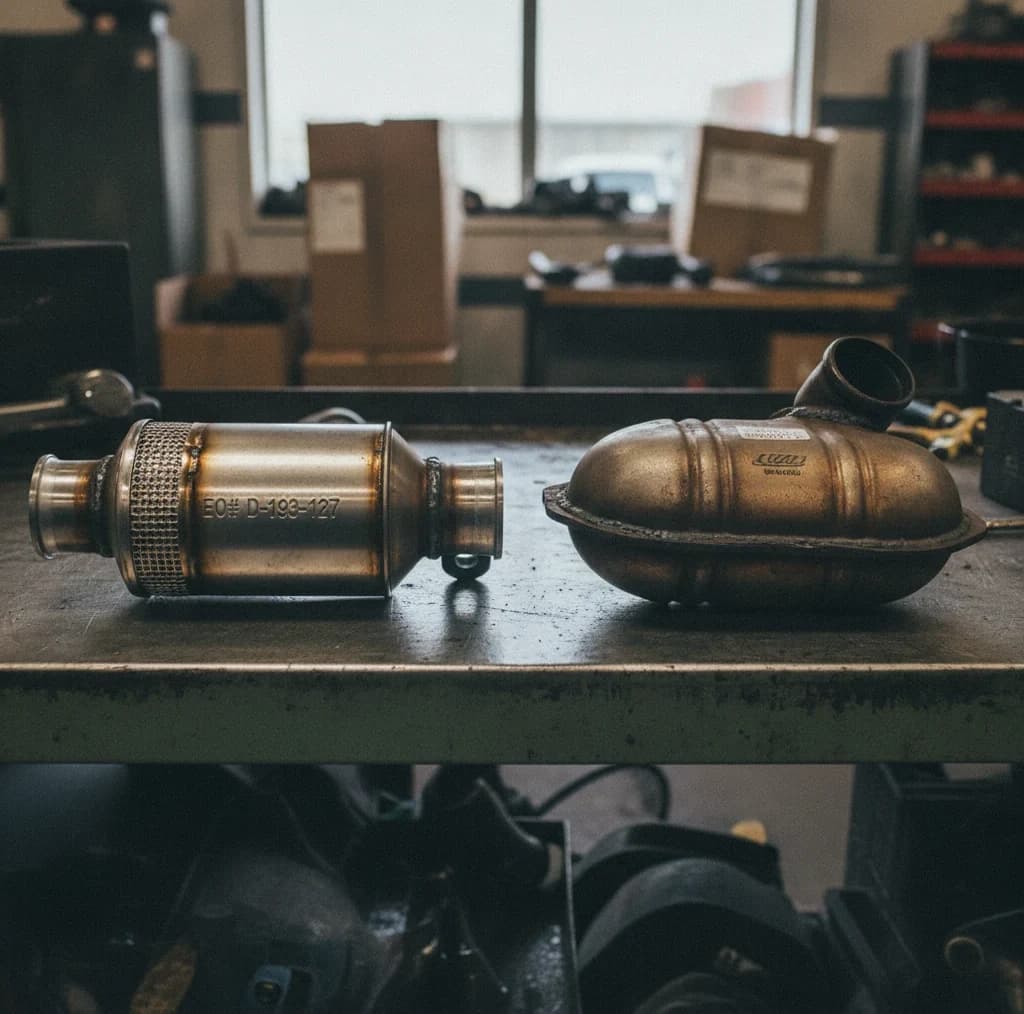
California requires CARB-certified converters, identified by an EO number stamped into the shell. A number of states have adopted California's emissions rules, and the list changes, so confirm your state's current position with its own inspection authority rather than relying on a product listing.
Everywhere else, EPA-compliant is the standard. Those converters are cheaper because they carry less precious metal.
Two practical cautions. Online listings routinely claim CARB compliance for parts that are not, so confirm the EO number is physically stamped on the part when it arrives. And if you might move to or register the car in a CARB state, buying the CARB part now is cheaper than doing the job twice.
Direct-fit or universal
| Direct-fit | Universal | |
|---|---|---|
| Part cost | $200-$1,700 | $80-$300 |
| Install | Bolts to existing flanges, 1-2 hr | Cut and weld, 2-3 hr |
| Sensor bungs | Already in the correct positions | Must be welded in and positioned correctly |
| Labor cost | $150-$400 | $200-$450 |
| Best for | Stock exhaust, most people | Modified or heavily rusted exhaust |
Universal converters look like the budget option and often are not once welding labor is added. Where they genuinely win is a car whose exhaust is already rotten enough that sections are being replaced anyway.
Sensor bung placement on a universal install is where things go wrong. Put the downstream sensor too close to the converter outlet and it reads hot, too far and it reads cold; either way the efficiency calculation is off and you get a P0420 on a perfectly good part.
Why the $90 converter comes back
A converter's job depends on how much platinum, palladium, and rhodium is washcoated onto the substrate. That loading is most of the manufacturing cost, and it is the easiest thing to cut.
A minimally loaded converter can pass a tailpipe sniff test when new. What it cannot do is hold that efficiency, and the ECU is watching continuously through the downstream sensor. Typical sequence: fitted, light goes out, three to eight months later P0420 returns, and you buy a second converter.
Two converters plus two lots of labor exceeds one good one. If a listed price is a small fraction of everything else for your vehicle, the difference is the metal that makes it work.
The used converter question
People ask us this constantly, so here is the straight answer. Federal rules restrict installing used converters, generally permitting it only where the unit has been tested and documented as still meeting standards. Most shops will not fit one, because the liability sits with the installer.
Beyond the legal position, there is a practical one. A used converter's remaining catalyst efficiency is unknowable by looking at it. It came off a car that was scrapped, possibly for an engine problem that damaged the converter. You may pass inspection or you may buy the part twice.
Where salvage genuinely helps is everything around the converter: heat shields, hangers, flanges, bolts, and sensor bungs. Those are cheap, plentiful, and unregulated.
Before you buy
- Confirm the fault is the converter, not an O2 sensor, an exhaust leak, or a misfire feeding it.
- Count how many you need. Many V6 and V8 engines have two or three, and a code may implicate one bank only.
- Check whether yours is manifold-integrated, which changes the price bracket entirely.
- Confirm the compliance standard for your state, and confirm the EO stamp on arrival if you need CARB.
- Ask about the old unit. It has scrap value, and the shop keeping it is a discount you can negotiate.
- Fit a shield at the same time if your vehicle is a common theft target. The labor is already being paid for.
Aftermath: clearing the code
The light will not go out immediately. The ECU runs its catalyst monitor over a drive cycle that includes cold start, steady cruise, and varied load, and it may take 50-150 miles before the monitor completes.
Do not clear codes right before an inspection. Clearing sets all readiness monitors to incomplete, and a car with incomplete monitors fails as surely as one with a fault. Drive it a week first.