
Key Takeaways
- $150-$500 per sensor installed. Part alone $40-$150, or $80-$250 for wideband
- Upstream controls fuel mixture. Downstream only monitors the converter
- Never buy used. A slow sensor reads plausible and quietly destroys the converter
- A P0420 converter code is sometimes a sensor. Check before spending four figures
What you pay
| Route | Part | Labor | Total per sensor |
|---|---|---|---|
| Dealer | $90-$250 | $100-$250 | $200-$500 |
| Independent shop | $50-$180 | $80-$200 | $150-$400 |
| DIY, accessible sensor | $40-$150 | Your labor | $40-$150 |
| DIY, seized sensor | $40-$150 plus extractor | An afternoon | $70-$200 |
Most four-cylinders have two sensors. V6 and V8 engines have four, sometimes more. Shops often quote replacing them in pairs, which is reasonable on a high-mileage car since they age together, but it is not required.
Knowing which sensor is which
Codes name sensors by bank and position, and getting this wrong means replacing the wrong part.
- Bank 1 is the side of the engine containing cylinder 1. On an inline engine there is only bank 1.
- Bank 2 is the other cylinder head on a V engine.
- Sensor 1 is upstream, before the converter.
- Sensor 2 is downstream, after it.
So P0135 for Bank 1 Sensor 1 heater circuit means the upstream sensor on the cylinder-1 side. Confirm which physical head is bank 1 for your engine before you start; it is not always the side you would guess, and on transverse V6 engines it frequently is not.
Why used is the wrong economy here
An O2 sensor does not usually stop working. It gets slow. The ceramic element becomes contaminated over tens of thousands of miles, and its response time stretches from milliseconds to something the ECU cannot use for real-time correction.
A slow sensor still produces a voltage in the normal range. It will not necessarily set a code. What it does is make the ECU chase the mixture slightly late, all the time, which shows up as worse fuel economy and a converter running hotter than it should.
Buy a used one and you are installing a sensor with unknown remaining response time to fix a problem caused by degraded response time. The part is $40-$150 new. Save your yard trip for the heat shields and the bolts.
Getting a seized sensor out
This is the actual difficulty of the job. Sensors thread into hot steel and stay there for a decade.
- Work on a warm engine, not a hot one. Warm metal releases more easily; hot exhaust burns you.
- Penetrating oil the night before if you can plan ahead.
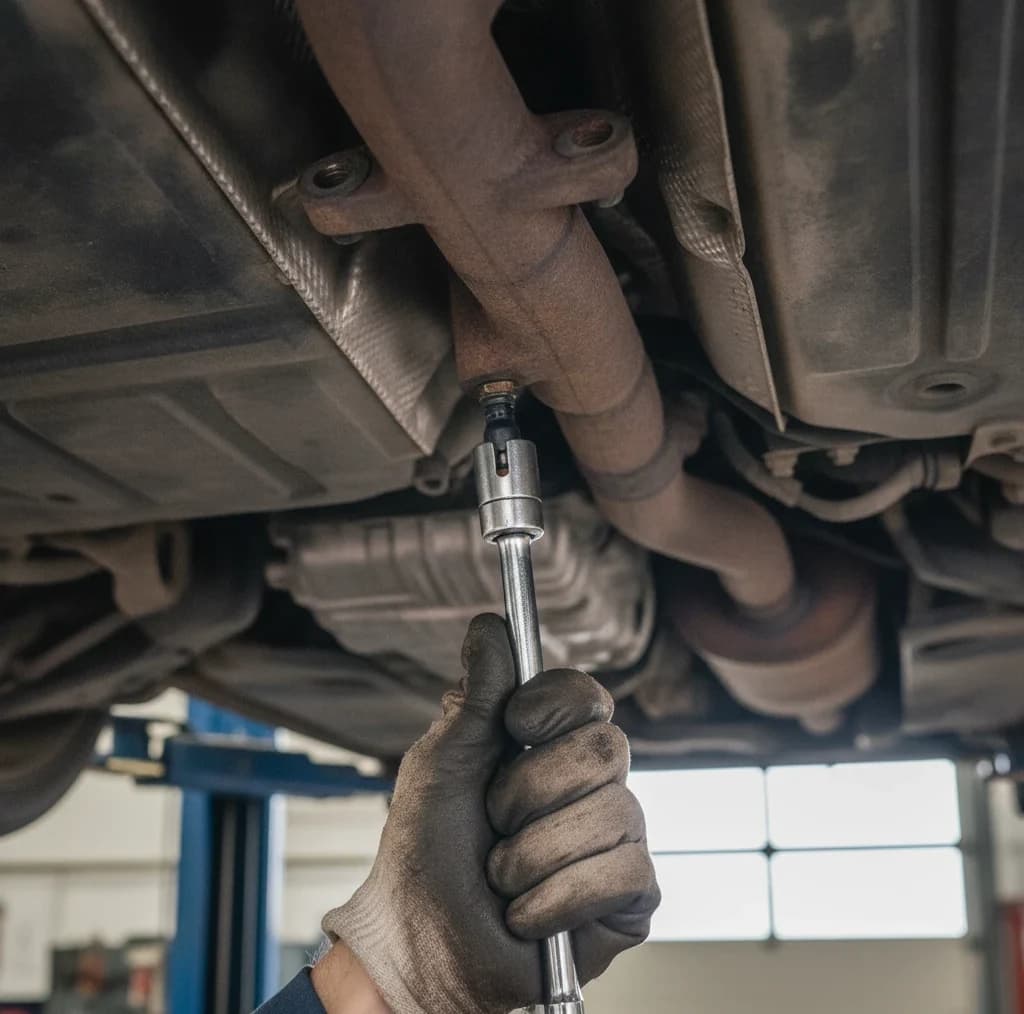
- Use a proper O2 sensor socket with the slot for the wire, or a crowfoot. An open-end wrench will round the hex.
- Anti-seize on the threads only when fitting the new one. Keep it off the sensor tip. Many sensors ship with compound already applied.
- If it will not move, stop before you snap it. A broken sensor body in the manifold means an extractor or a new manifold.
- Do not overtighten. Torque to spec, usually 30-45 lb-ft. Overtightening cracks the ceramic inside.
Before replacing a converter, check the sensors
A P0420 code means the ECU compared the upstream and downstream signals and concluded the converter is not doing enough. That comparison depends entirely on the sensors being accurate.
With a scan tool reading live data, an upstream sensor on a warm engine should oscillate rapidly between roughly 0.1 and 0.9 volts. A downstream sensor should sit relatively steady around 0.6-0.7 volts. If the downstream signal mirrors the upstream one closely, either the converter is genuinely finished or the downstream sensor is reporting badly.
Exhaust leaks upstream of a sensor produce the same picture, because extra oxygen entering through the leak makes the mixture read lean. Check for leaks at the manifold gasket and flex pipe before condemning anything expensive. The difference is a $60 part against a $1,500 one.