
Key Takeaways
- Dealer OEM: $1,000-$3,000. Aftermarket EPA: $400-$1,500. CARB-compliant: $700-$2,200
- Rhodium content is why a small steel canister costs more than a transmission rebuild in parts
- A converter that failed early was killed by something upstream. Find it first
- Used converters are federally restricted and many shops will not install one
Where the money goes
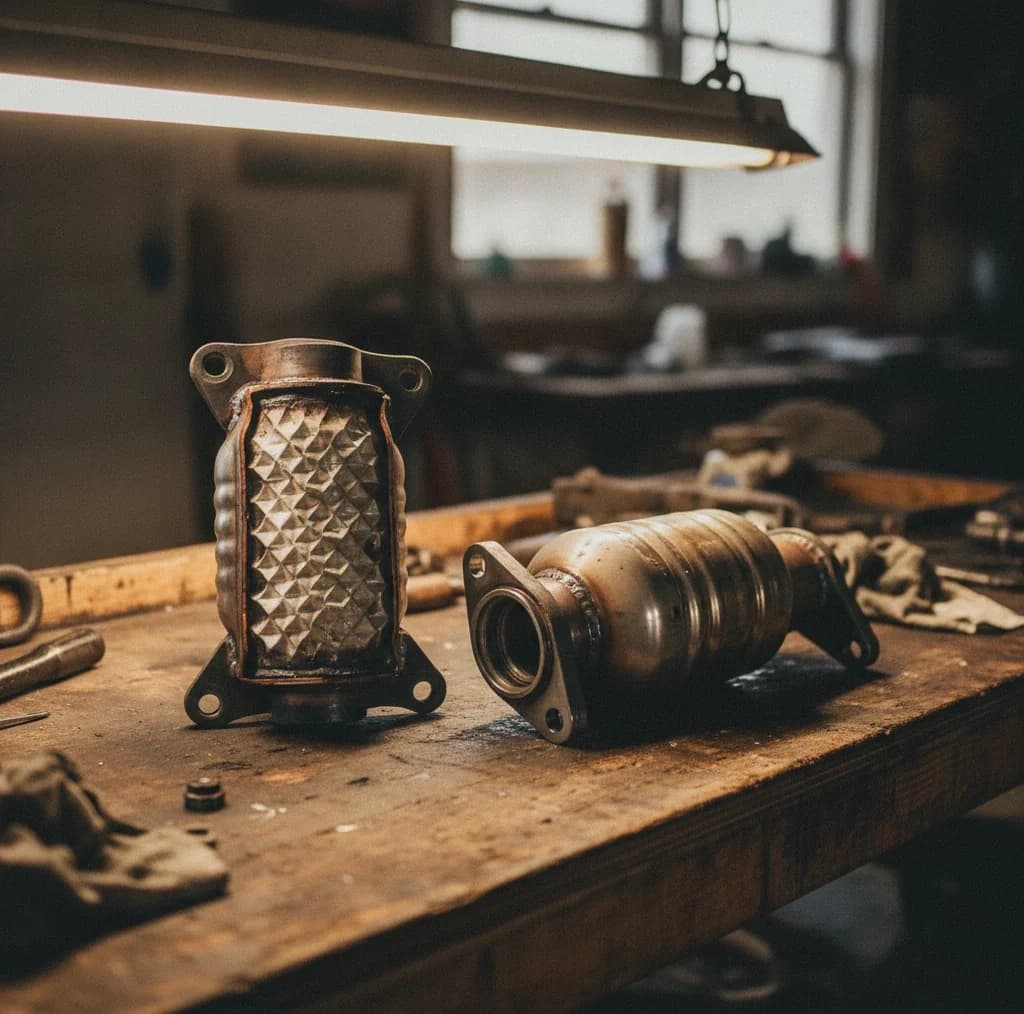
A catalytic converter is a ceramic honeycomb coated with platinum, palladium, and rhodium. The metals are the cost. Rhodium has traded at multiples of gold in recent years, and although a converter contains only a few grams, that is enough to set the price floor for the whole part.
| Type | Part | Labor | Total |
|---|---|---|---|
| Dealer OEM | $800-$2,500 | $150-$500 | $1,000-$3,000 |
| Aftermarket direct-fit, EPA | $200-$1,000 | $150-$500 | $400-$1,500 |
| Aftermarket direct-fit, CARB | $450-$1,700 | $200-$500 | $700-$2,200 |
| Universal weld-in, EPA | $80-$300 | $150-$400 | $230-$700 |
| Manifold-integrated assembly | $700-$2,200 | $300-$800 | $1,000-$3,000 |
Two design details push a quote to the top of that range. Engines with the converter cast into the exhaust manifold require the whole assembly. And V6 and V8 engines often have two or three converters, so a single failed unit can still mean replacing a bank.
EPA versus CARB, and why it matters to your bill
There are two aftermarket compliance standards, and buying the wrong one wastes the money entirely.
EPA-compliant converters are legal in most states. CARB-compliant converters meet California's stricter standard and carry an EO number stamped on the shell. California requires CARB parts, and several states have adopted its rules. If you live in one and fit an EPA-only converter, it will fail inspection regardless of how well the car runs.
Check your state before ordering, and if you are in a CARB state, confirm the EO number is physically stamped on the part when it arrives. Listings are not always accurate.
Find out what killed it
This is the part that saves people from paying twice. Converters do not usually wear out on their own within a normal service life. Something upstream destroys them.
| Upstream cause | What it does | Sign |
|---|---|---|
| Misfire | Raw fuel ignites in the converter and melts the substrate | P0300-series codes, rough idle |
| Burning oil | Phosphorus coats the catalyst surface | Blue smoke, oil consumption |
| Coolant intrusion | Silicates poison the catalyst permanently | Sweet smell, white smoke, coolant loss |
| Rich fuel trim | Overheats the substrate over time | Long-term fuel trim well negative, black smoke |
| Failed upstream O2 sensor | ECU runs the wrong mixture for months | Sensor codes, poor economy |
| Physical impact | Cracks the ceramic, which then rattles | Rattle on start, road debris damage |
A P0420 code says the converter is not working as efficiently as expected. It does not say the converter is the broken part. Before spending four figures, check fuel trims, look for misfires, and confirm the upstream and downstream sensors are actually reading correctly. A $60 sensor sets that code often enough to be worth ruling out.
Theft, which is the other reason people are reading this
Converter theft targets what is easy to reach and rich in metal: high-clearance trucks and SUVs, and hybrids, whose converters run cooler and retain more of their precious metal loading.
If yours was stolen, check your comprehensive coverage before paying out of pocket. Theft is normally a comprehensive claim, and on a $1,500-$3,000 replacement the deductible is usually worth it.
When you replace it, this is the moment to fit a shield or cage. They are $150-$500 and they turn a two-minute cut into a job most thieves will skip. Etching the VIN into the shell costs nothing and makes a recovered unit traceable.
What you can legitimately do with the old one
A failed converter still contains its metals, and scrap value is real: commonly $50-$250 for a standard unit and considerably more for some hybrid and European converters. Any shop replacing it will offer to keep the old one, which is worth noticing — that is a discount you can ask for rather than a disposal favour.
Sell it yourself and expect to show ID and, in many states, proof of ownership of the vehicle. That paperwork exists because of theft, and legitimate buyers will insist on it.