
Key Takeaways
- Dealer $800-$2,000. Reman pre-programmed $250-$600. Yard $40-$120 plus programming
- Whether programming is needed is entirely make and year dependent. Check before buying
- Bad grounds and corroded connectors imitate a dead module. Rule those out first
- A reman using your own module keeps the VIN and immobiliser data intact
Rule out the cheap causes
Modules fail far less often than they get blamed. The symptoms of a dead ECU and a bad ground are close to identical, and one of them costs nothing to fix.
- Grounds. Engine-to-chassis and chassis-to-body straps corrode, and every sensor reading drifts as a result. Clean them and retest.
- Power supply and fuses. Check for battery voltage and switched power at the module connector before condemning it.
- Water intrusion. Many modules sit where water collects, under a cowl or in a footwell. Pull the connector and look for green pins.
- Rodent damage. Chewed insulation shorting a sensor circuit produces multiple simultaneous codes, which is the pattern people read as module failure.
- Battery condition. Low voltage during cranking makes modules behave erratically and sets communication faults.
- Aftermarket wiring. Alarms, remote starters and stereo installs are a common source, especially where someone tapped a signal wire.
If a scan tool cannot communicate at all, check the diagnostic connector's power and ground pins before assuming the module is dead. A blown fuse on that circuit produces a convincing imitation.
Three tiers of difficulty
| Era | Used module viability |
|---|---|
| Pre-1996 | Usually plug and play. Match the part number and go |
| 1996-2004 | Often plug and play. Some need a key or immobiliser relearn |
| 2005-2012 | Usually needs VIN programming. Widely doable at independent shops |
| 2013 on | Frequently dealer-only, often refuses a previously married module |
That last row is the important one for anyone shopping a yard. On many modern vehicles a module that has been coded to one VIN cannot be recoded to another, so a used unit is worthless regardless of condition. Check your specific make and year before spending anything, including the entry fee.
Where used modules genuinely shine
On the right car this is one of the best value plays in a salvage yard. A dealer module is $800-$2,000. The yard price is the same flat $40-$120 that any module costs, whether it came from a Corolla or an S-Class.
The cars where this works well: anything pre-2005 with a matching part number, body control and comfort modules that are not immobiliser-linked, ABS and transmission modules on makes that allow coding, and radio and cluster modules on vehicles where those are not VIN-locked.
Note that clusters are their own problem. Many store mileage, and swapping one raises both legal and practical issues around odometer accuracy. Several states require disclosure. This is one to research before buying rather than after.
The alternative that avoids programming entirely
Several specialist companies repair modules on exchange. You send yours, they fix the common failure — usually cracked solder joints, failed capacitors or a corroded driver transistor — and return your own unit.
Because it is your module, the VIN, immobiliser data and calibration are unchanged. It plugs back in and works. Cost is typically $150-$400 with a warranty, and turnaround is a few days.
On a car where dealer programming is $200-$400, that is often cheaper than a $60 yard module plus the programming to make it work. It is close to always the right answer on European vehicles.
Pulling one at a yard
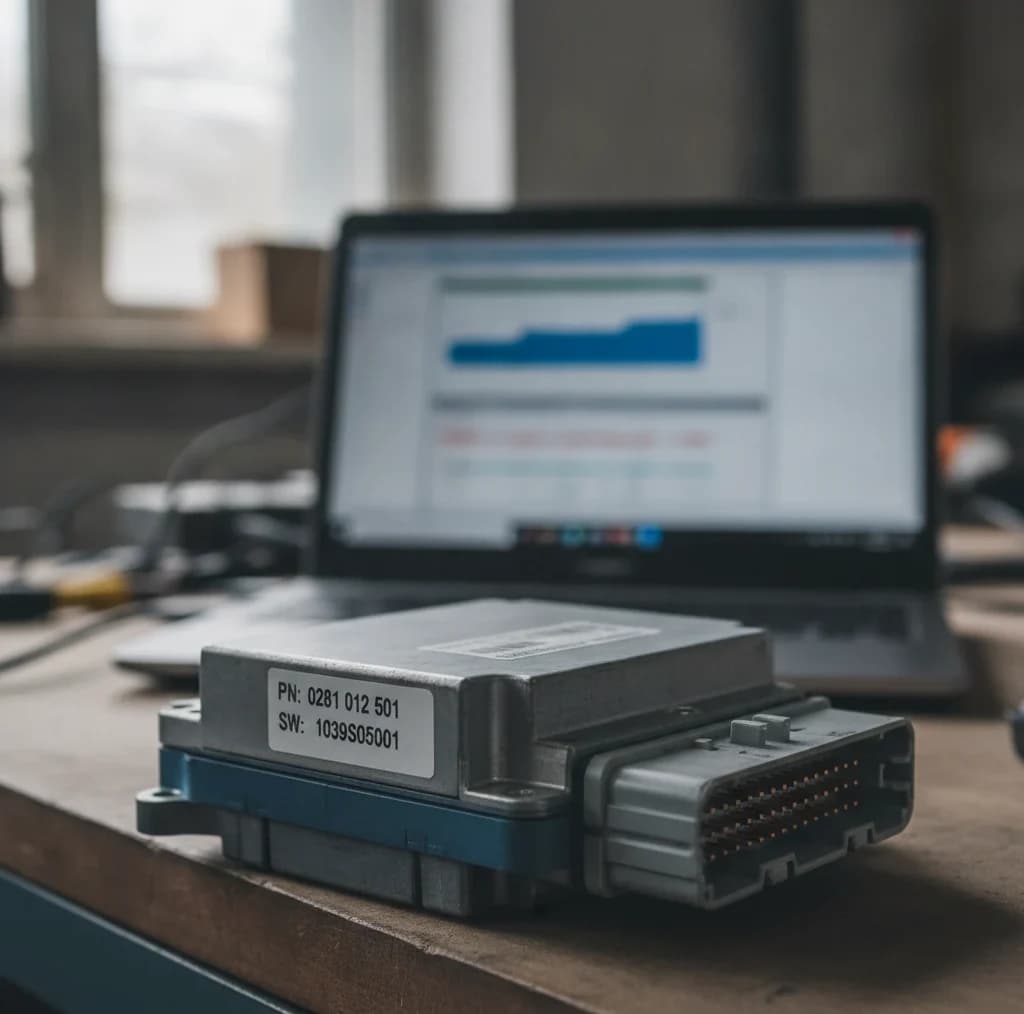
- Match the full part number, every character including suffix. Hardware and software revisions matter.
- Photograph the donor's VIN, which programming shops sometimes need and which proves provenance.
- Take the connectors and pigtails if they unplug, along with the mounting bracket.
- Check the pins for corrosion and the case for water staining.
- Take the ignition lock and keys if the immobiliser is involved. On some makes a matched module, lock and key set can be programmed together where a lone module cannot.
- Avoid flood cars without exception for anything electronic.
After installation
Expect a relearn period even when everything programmed correctly. The module has to learn idle characteristics, fuel trims and often transmission adaptives, and the car may idle oddly or shift firmly for the first fifty to a hundred miles.
Emissions readiness monitors also reset. If you need an inspection, drive it a week first so the monitors complete. A car with incomplete monitors fails inspection the same as one with a fault code.