
Key Takeaways
- Dealer: $400-$700. Independent shop: $250-$500. Reman over the counter: $120-$300
- Used starter at a self-service yard: $20-$45, and you can test it before you pay
- One loud click with bright lights is a starter. Rapid clicking with dim lights is a battery
- Starters interchange widely across an engine family, so the donor does not need to be your model
What you pay, by route
| Route | Part | Labor | Total |
|---|---|---|---|
| Dealer (new OEM) | $250-$450 | $150-$250 | $400-$700 |
| Independent shop (reman) | $120-$250 | $130-$250 | $250-$500 |
| Parts store reman, DIY | $120-$300 | Your labor | $120-$300 |
| Salvage yard, DIY | $20-$45 | Your labor | $20-$45 |
| Salvage yard part, indie shop installs | $20-$45 | $130-$250 | $150-$295 |
That last row is the one most people overlook. Plenty of independent shops will fit a part you supply, though they will not warranty the part itself. On a starter that trade is reasonable, because you already tested it.
Make sure it is actually the starter
We watch people buy starters they did not need about once a week. The symptoms overlap with a weak battery and with corroded cables, and the cheapest of the three to fix is the one people check last.
| Symptom | Most likely cause |
|---|---|
| One loud click, headlights stay bright | Starter or solenoid |
| Rapid clicking, headlights dim | Battery or charging system |
| Nothing at all, no dash lights | Battery, main fuse, or ignition switch |
| Slow crank, battery passes load test | Starter drawing excess current |
| Grinding on start | Drive gear or flywheel ring gear |
| Works when cold, fails when hot | Starter, heat-soaked windings |
Before you pull anything, clean the battery terminals and check that the ground strap from engine to chassis is tight. A corroded ground produces the exact same single click, and it costs nothing to rule out.
The heat-soak case is worth calling out because it is easy to misdiagnose. The car starts fine in the morning, then refuses after you park it warm for twenty minutes. That is a starter on its way out, not an intermittent electrical gremlin.
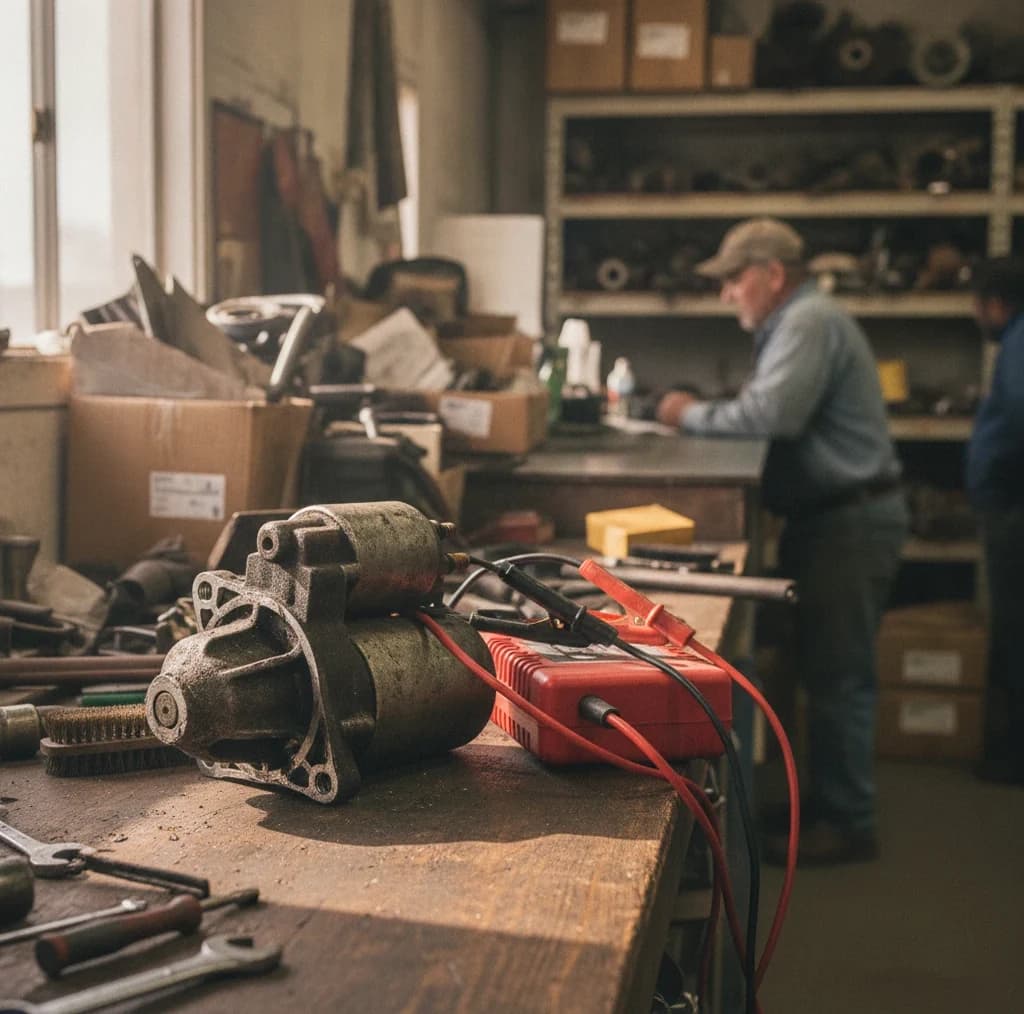
Testing a used starter in the yard
This is the reason a used starter is a reasonable buy when a used alternator is a coin flip. You can prove it works before you hand over money.
- Bring a jump pack and a short jumper cable. Clamp the pack negative to the starter housing and positive to the large battery terminal on the starter.
- Jump the solenoid. Run your short cable from that same large terminal to the small spade terminal. The starter should spin hard and the drive gear should kick out.
- Watch the gear, not just the motor. A motor that spins without the gear extending means a bad solenoid plunger. That is the most common used-starter failure.
- Listen for the return. The gear should snap back immediately when you break the connection. A lazy return will leave the gear engaged and chew your flywheel.
- Spin the gear by hand. It should turn one direction and lock the other. If it slips both ways the one-way clutch is gone.
A starter that passes all five is very likely fine. It is a simple machine, and the failure modes are all things you just checked.
Interchange: the donor does not have to match your badge
Starters follow the engine, not the model. A starter bolts to the bellhousing and engages a ring gear, so what matters is the engine family, the transmission type, and the tooth count on the drive gear.
| Engine family | Commonly shared across |
|---|---|
| GM LS (4.8/5.3/6.0) | Silverado, Sierra, Tahoe, Suburban, Escalade, Express |
| Ford Modular 4.6/5.4 | F-150, Expedition, Crown Victoria, Mustang GT |
| Chrysler 3.6 Pentastar | Grand Cherokee, Wrangler, Charger, Town & Country |
| Toyota 2GR-FE V6 | Camry, Highlander, Sienna, RAV4, Avalon |
| Honda K-series | Accord, CR-V, Civic Si, Element |
This widens the search enormously. If your yard has no Camry, a Sienna with the same 2GR-FE will do. Compare the casting number on the old unit against the donor and check that the mounting ear pattern and the plug match.
Two cautions. Manual and automatic applications sometimes use different tooth counts, so match transmission type. And some models moved to a higher-output starter mid-generation for stop-start systems; those are not interchangeable backwards.
When the labor number jumps
On most four-cylinders the starter is on the front of the block, held by two bolts, reachable from underneath in under an hour. On some V6 and V8 layouts it lives in the valley under the intake manifold, and getting to it means pulling the plenum, the fuel rail, and sometimes the injectors.
Northstar V8s, some Chrysler 3.5/3.6 applications, and a number of Audi V6 layouts fall in this group. Book time goes from one hour to four or five, and the shop bill goes with it. If your car is one of these, the $20 used starter matters much less than getting the diagnosis right the first time, because nobody wants to do that job twice.