
Key Takeaways
- Independent shop: $500-$1,200. Dealer: $900-$1,800. DIY parts only: $60-$200
- Never buy a used timing belt. It is a wear item with unknown remaining life
- Most engines built after 2010 use a chain instead and need no scheduled replacement
- The salvage yard matters after a belt snaps, not before: a used cylinder head runs $150-$400 against $1,200-$2,500 for a rebuild
What the job actually costs
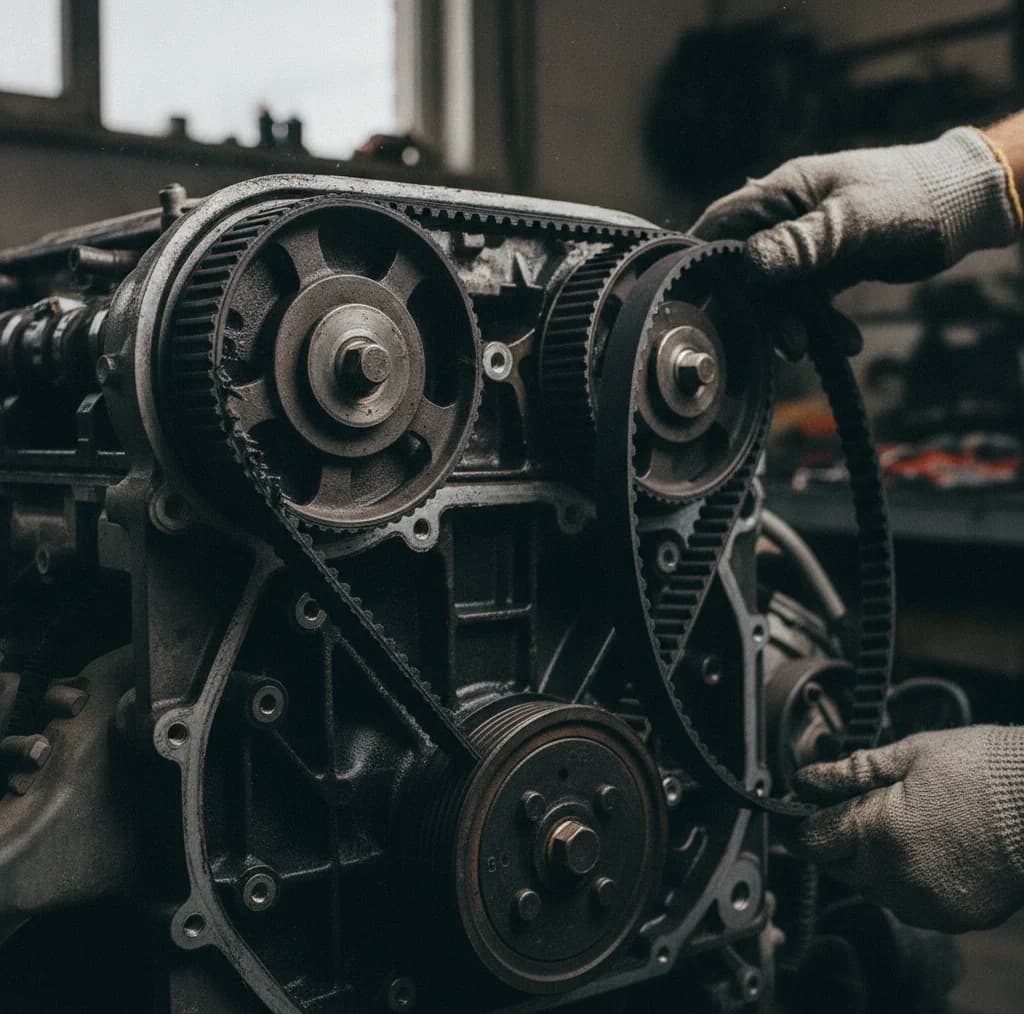
Almost none of the money goes to the belt. A quality kit is $60-$200. Everything else is the four to eight hours it takes to get to it, because the belt sits behind the accessory drive, the crank pulley, and usually an engine mount.
| Route | Parts | Labor | Total |
|---|---|---|---|
| Dealer | $200-$400 | $700-$1,400 | $900-$1,800 |
| Independent shop | $120-$300 | $380-$900 | $500-$1,200 |
| Independent shop, belt + water pump | $200-$450 | $450-$950 | $650-$1,400 |
| DIY | $60-$200 | Your weekend | $60-$200 |
If the water pump is driven by the timing belt, replace it at the same time. The pump is a $40-$120 part and the labor is already paid for. Doing it separately later means paying that same four to eight hours twice.
Which engines still use a belt
This trips people up, because the answer changed. Manufacturers moved to chains through the 2000s and 2010s, so a 2004 and a 2016 version of the same nameplate can differ.
| Engine | Common in | Interval | Interference? |
|---|---|---|---|
| Honda J-series V6 | Accord, Odyssey, Pilot, Ridgeline | 105,000 mi | Yes |
| Subaru EJ25 | Outback, Forester, Impreza | 105,000 mi | Yes |
| Toyota 5VZ-FE 3.4L V6 | 4Runner, Tacoma, T100 | 90,000 mi | No |
| VW/Audi 1.8T | Jetta, Passat, A4 | 75,000-105,000 mi | Yes |
| Hyundai/Kia Beta & Sigma | Elantra, Sonata, Optima | 60,000 mi | Yes |
The interference column is the one that matters. On an interference engine the valves and pistons occupy the same space at different moments, and the belt is what keeps them from meeting. Lose the belt and they meet.
Why a junkyard belt is a bad idea
We sell used parts for a living and we still tell people to buy this one new.
A timing belt is rubber with a service life measured in miles and years. A belt pulled from a yard car has no history. You do not know if it has 20,000 miles on it or 90,000, whether the car sat outside for three summers, or whether it was already overdue when the car was scrapped. The part costs $60. The failure costs a cylinder head.
What is worth pulling at a yard is the hardware around the belt. Timing covers crack when they are pried off. Crank bolts get rounded. Tensioner brackets and idler pulleys get damaged by a stuck bolt. Those are $15-$40 used instead of $60-$150 new from a dealer, and unlike the belt, a bracket does not wear out.
After the belt breaks: the part that saves real money
This is where a salvage yard changes the math. A snapped belt on an interference engine usually bends intake valves. Sometimes it cracks a piston. The shop quote comes back as a head rebuild or a whole engine, and both numbers are large enough that people start pricing a different car.
| Fix | Parts | Labor | Total |
|---|---|---|---|
| Machine shop rebuilds your head | $400-$900 | $800-$1,600 | $1,200-$2,500 |
| Used head from a salvage yard | $150-$400 | $800-$1,600 | $950-$2,000 |
| Used complete engine, installed | $600-$1,800 | $800-$1,500 | $1,400-$3,300 |
| Used engine, DIY swap | $600-$1,800 | Your labor | $600-$1,800 |
On a high-mileage engine the used complete engine is often the better buy even though it looks more expensive. You are replacing worn rings, bearings, and a timing belt of unknown age along with the damaged head, instead of bolting a fresh head onto a tired bottom end.
Pulling a head or engine at a self-service yard
- Match the casting number, not the model year. Manufacturers run changes mid-year. The number stamped on the head is the only reliable match.
- Pull the valve cover before you buy. Milky residue means coolant got in. Heavy varnish means the oil was never changed. Both are reasons to walk to the next car.
- Check the timing belt on the donor. If it is intact and the engine turns freely by hand, the donor was probably scrapped for something unrelated, which is what you want.
- Take the intake and exhaust manifold bolts too. They seize and snap on your car, and a bag of used bolts costs a few dollars against a dealer order and a two-day wait.
- Bring a breaker bar and a harmonic balancer puller. The crank bolt is torqued high and nobody at the yard will have the tool.
When to just do the maintenance
If your car is within 10,000 miles of the interval and the engine is an interference design, the $500-$1,200 is cheap insurance against a $1,400-$3,300 repair. If you are 30,000 miles past the interval on a Honda J-series, stop reading and book the appointment.
The one case for waiting is a non-interference engine on a car you plan to sell soon. A snapped belt on a Toyota 5VZ-FE strands you but does not destroy anything. That is a tow bill and a belt job, not an engine.