
Key Takeaways
- Belt-driven: $400-$900. Timing-belt driven: $650-$1,400. Behind the chain cover: $900-$1,800
- The pump is $40-$150. Everything else is access
- Never buy this one used. Replacing it twice costs more than the part ever saves
- If it is timing-belt driven, replace the belt at the same time and vice versa
Three engines, three very different bills
The single question that sets the price is where the pump lives.
| Layout | Access | Labor | Total |
|---|---|---|---|
| Accessory-belt driven, front of block | Remove serpentine belt and pulley | 1.5-3 hr | $400-$900 |
| Timing-belt driven | Full timing belt teardown | 4-8 hr | $650-$1,400 |
| Behind the timing chain cover | Remove the front cover, often the mount | 6-12 hr | $900-$1,800 |
| Electric auxiliary pump | Usually accessible | 1-2 hr | $300-$700 |
The third row catches people out. Several modern engines put the pump inside the front cover driven off the timing chain, which turns a routine repair into most of a day. A number of GM Ecotec, Ford EcoBoost, and BMW N-series applications fall here. Before you accept a quote that looks high, it is worth asking which of these three your engine is, because it explains the number.
Why used is the wrong call here
A water pump is a bearing, a seal, and an impeller. The bearing wears. The seal hardens. Neither is inspectable on a part sitting in a bin, and both are the reason the pump you are replacing failed.
Then there is the impeller. Some pumps use a composite impeller that erodes or slips on the shaft, and the damage is inside the housing where you cannot see it. A pump can spin freely by hand and still move almost no coolant.
New is $40-$150. If the labor behind it is four hours, the used pump has to last the life of the car to break even, and it will not.
What is worth pulling at a yard is the hardware: the pulley, the tensioner, the thermostat housing that cracks when you remove it, and bolts that snap. Those do not wear out.
Catching it before it strands you
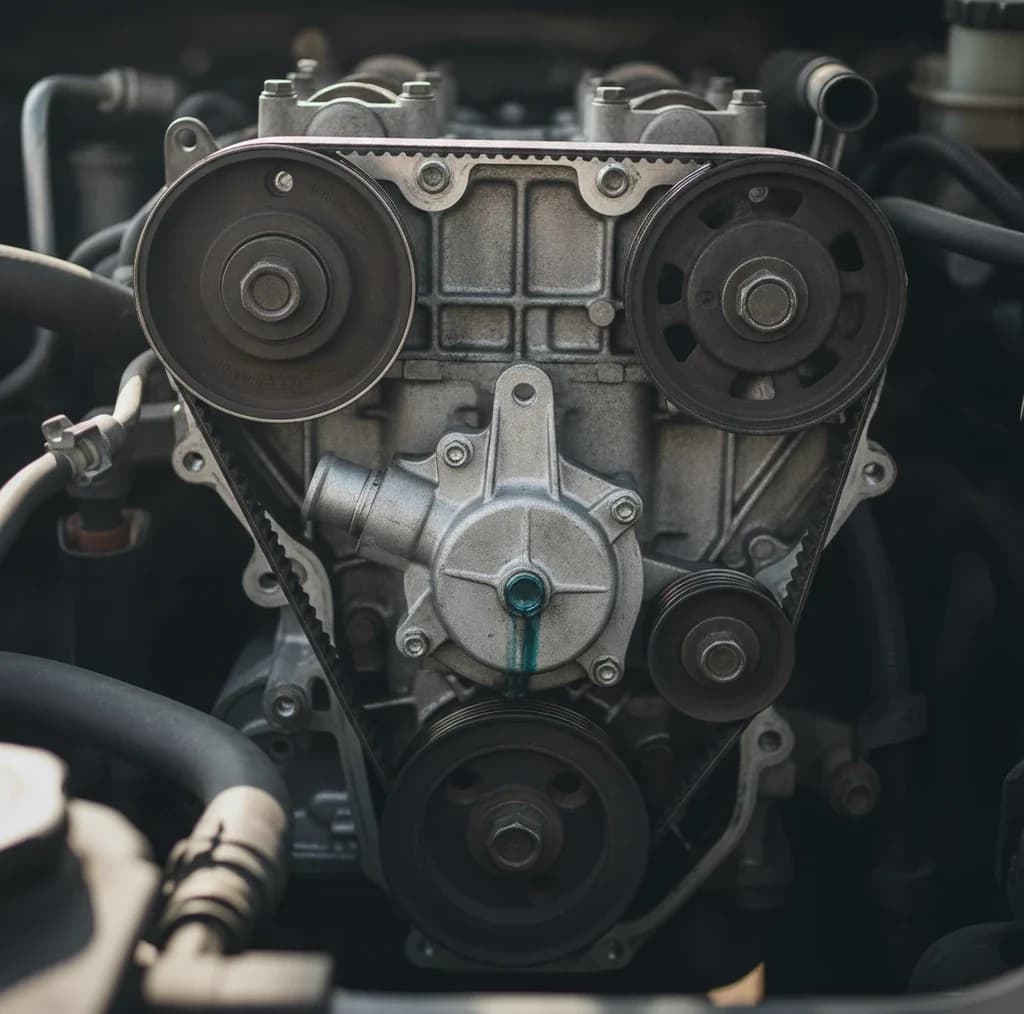
- Weep hole drip. Every pump has a small hole under the shaft designed to leak when the seal fails. Coolant crust there is the earliest reliable sign.
- Play in the pulley. Engine off, belt removed, rock the pulley top to bottom. Any movement means the bearing is going.
- Noise that tracks engine speed. A whine or growl that rises with rpm and does not change when you press the clutch.
- Overheating that gets worse at low speed. A worn impeller still moves some coolant at high rpm and almost none at idle.
- Coolant loss with no visible leak. Check under the timing cover before assuming a head gasket.
On timing-belt engines, the warning signs often do not appear. This is the argument for replacing the pump on the belt interval whether or not it has symptoms: when the pump bearing seizes it shreds the belt, and on an interference engine that is a cylinder head.
Doing it right
Two failures account for most repeat jobs, and neither is the pump.
Sealing surface. The old gasket has to come off completely without gouging the aluminum. A scraper will leave marks that weep. Use a plastic scraper and a solvent, then check the surface is flat.
Air in the system. A trapped air pocket reads as overheating on a perfect repair. Use the bleed screw if there is one, park nose-high if there is not, and run with the cap off until the thermostat opens and the level stabilises.
Replace the thermostat while you are in there. It is $15-$40, it lives in the same coolant, and it is a common cause of the overheating people blame on the new pump.