
Key Takeaways
- Bolt-on hub: $300-$700 per corner. Pressed-in bearing: $400-$800
- Tone ring tooth count and ABS sensor type matter as much as bolt pattern
- Noise that changes when you steer left and right is the bearing test that works
- Marginal used buy: the bearing is a wear item and the job is mostly labor
Two designs, two very different jobs
Before pricing anything, find out which your car has.
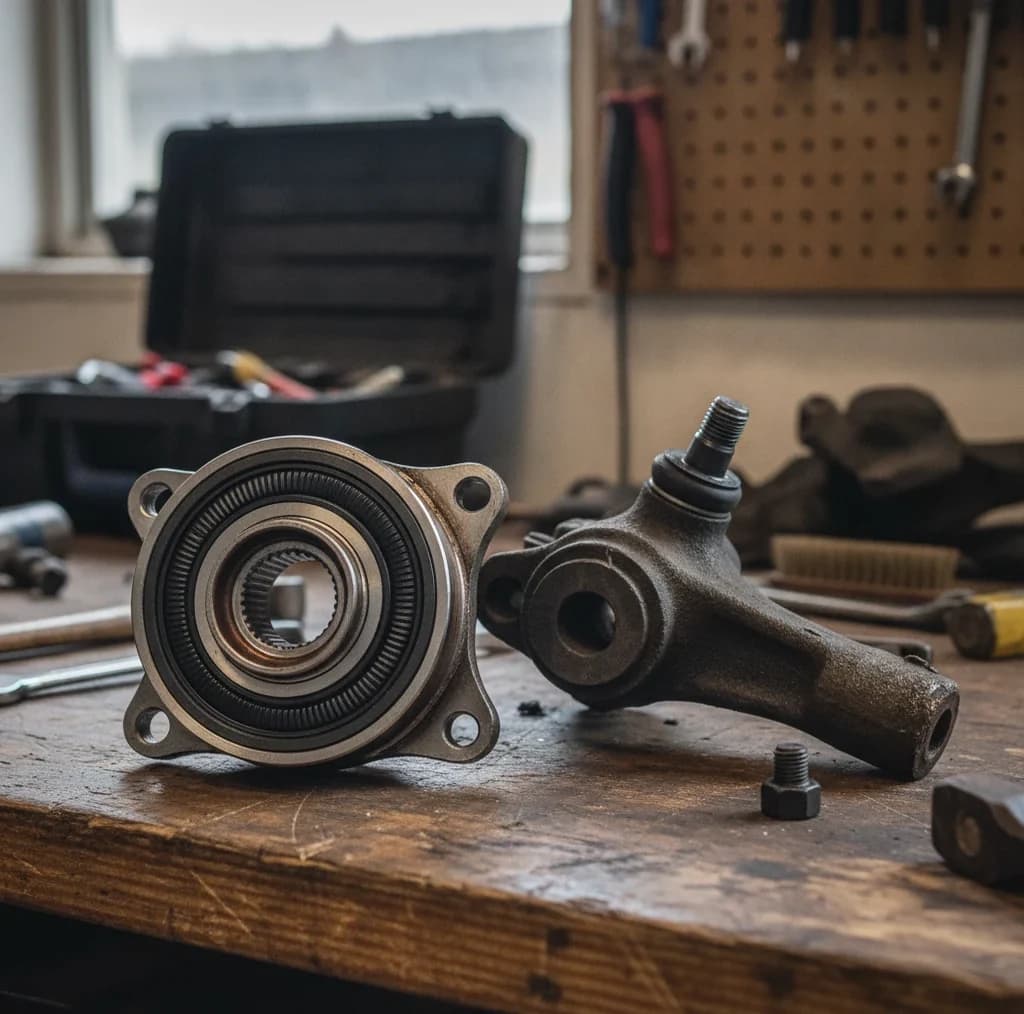
Bolt-on hub assembly. Bearing, hub, flange, and often the ABS sensor come as one sealed unit that bolts to the knuckle with three or four bolts. Common on most vehicles from the mid-1990s onward. Roughly an hour per corner once the bolts release.
Pressed-in bearing. The bearing presses into the knuckle and the hub presses into the bearing. Requires a shop press or an on-car press kit, and usually means removing the knuckle. Two to three hours per corner, and the part is cheaper while the labor is not.
Confirming it is the bearing
| Test | Bearing | Something else |
|---|---|---|
| Noise changes with road speed | Yes | Engine-speed noise is not a bearing |
| Louder turning one way, quieter the other | Classic bearing sign | Constant noise suggests tires |
| Rock the wheel at 12 and 6 | Play means bearing | Play at 9 and 3 means tie rod or ball joint |
| Spin the wheel by hand, lifted | Roughness or rumble | Smooth means look elsewhere |
| ABS light with one wheel code | Possible tone ring damage | Sensor or wiring is more common |
Tire noise is the frequent misdiagnosis. Cupped or feathered tires produce a very similar hum. Rotate the tires and see whether the noise moves; if it does, it was never the bearing.
What has to match for interchange
- Bolt pattern and stud count. The obvious one, and the least likely to be the problem.
- Hub bore and pilot diameter, which centres the wheel.
- Knuckle flange pattern. Bolt spacing to the knuckle differs between trims more than people expect.
- Driven or undriven. A driven hub is splined for the axle. A rear hub on a front-wheel-drive car is not.
- ABS sensor type. Some hubs have an integral active sensor, some use a passive sensor reading a separate ring, and some have no provision at all.
- Tone ring tooth count. This is the one that catches people. The ABS module counts teeth to calculate speed, and a different count produces wheel speed errors even though everything bolts together.
- Brake package. Larger brake options sometimes come with a different hub offset.
The reliable method is to photograph the part number on your existing hub and match it. Catalogue lookups by year and model miss mid-year revisions and option-dependent variants regularly.
Whether to buy used
We will be honest about this one: it is one of the weaker salvage buys.
The bearing is a wear item with a service life you cannot assess. Spinning it by hand tells you whether it is already bad, not whether it has 20,000 or 90,000 miles left. And because the job cost is mostly labor, a used hub that fails in a year means paying that labor twice to save $100 on the part.
Where used makes sense: expensive applications where a new OEM hub is $400-$700, or when the failure is the tone ring rather than the bearing, or when you need the hub for a brake or wheel conversion rather than to fix a failure.
If you do buy used, check that the tone ring is clean and undamaged, spin it slowly listening for any grinding, check for the slightest play, and look for rust staining around the seal that indicates water got in.
Fitting notes
- Break the axle nut before lifting the car. It is torqued to 150-250 lb-ft and the wheel has to be on the ground to hold it.
- Torque the axle nut to spec and use a new one if it is a staked or crimped type. Overtightening preloads the bearing and destroys it early.
- Do not hammer the hub in. Impact through the bearing races brinells them, and the new part will hum within weeks.
- Clean the knuckle bore. Corrosion there stops the hub seating square, which loads the bearing unevenly.
- Handle the tone ring carefully. It is magnetic on many modern hubs and picks up metal filings that produce erratic wheel speed readings.
- Anti-seize on the mating face, not the bolt threads, unless the manufacturer says otherwise.