
Key Takeaways
- Four-cylinder: $1,500-$3,500. V6 or V8: $2,500-$5,000. The gasket itself is $80-$300
- A $40 combustion leak test confirms it in five minutes. Do that first
- On a high-mileage engine a used replacement often costs the same and fixes everything
- Find out why it overheated. A gasket that failed from a bad fan will fail again
Confirm it before you spend anything
Overheating and coolant loss have several causes, most of them cheaper than this one. Three tests separate them.
| Test | Cost | Result that means head gasket |
|---|---|---|
| Combustion leak test | $40 kit | Test fluid changes color, meaning exhaust gas in the coolant |
| Compression test | $50 gauge | Two adjacent cylinders low, others normal |
| Cylinder leak-down | $70 kit | Air escaping into the cooling system, bubbles in the radiator |
| Cooling system pressure test | Shop, $50-$100 | Loses pressure with no external leak |
The combustion leak test is the decisive one, because nothing except a breach between combustion chamber and coolant puts exhaust gas in the cooling system.
What people mistake for a head gasket: a failed radiator cap holding no pressure, a leaking heater core dumping coolant into the carpet, a cooling fan that stopped working, a stuck thermostat, or an external leak that only shows up hot. All are much cheaper.
What drives the labor
| Engine | Labor | Parts | Total |
|---|---|---|---|
| Inline 4, timing chain | 8-12 hr | $150-$400 | $1,500-$3,000 |
| Inline 4, timing belt | 10-14 hr | $200-$500 | $1,800-$3,500 |
| V6, both heads | 14-20 hr | $300-$700 | $2,500-$4,500 |
| V8, both heads | 16-22 hr | $350-$800 | $3,000-$5,000 |
| Subaru boxer | 12-18 hr | $250-$600 | $2,200-$4,000 |
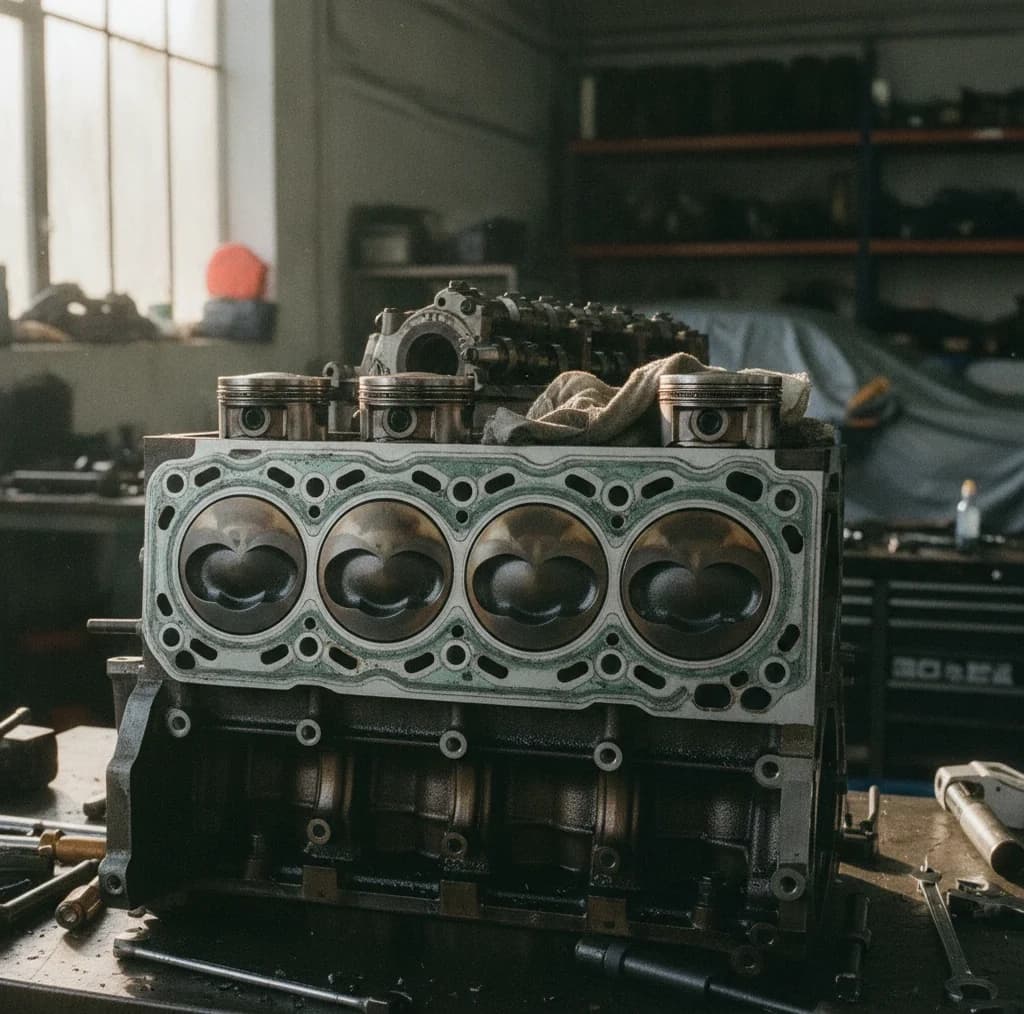
Machine shop work is usually extra and usually necessary. A head that overheated is rarely flat, and bolting a new gasket to a warped surface fails again within months. Resurfacing runs $100-$250 per head, a pressure check for cracks $50-$100, and a valve job if needed $200-$500.
Head bolts are frequently torque-to-yield, meaning they stretch permanently and cannot be reused. That is another $40-$150 that some quotes leave out.
Repair or replace the engine
This is the decision that actually matters, and it turns on mileage.
| Option | Cost | What you end up with |
|---|---|---|
| Head gasket repair | $1,500-$5,000 | One fault fixed on an otherwise worn engine |
| Used engine, shop installed | $1,400-$3,300 | Lower-mileage engine, everything reset |
| Used engine, DIY swap | $600-$1,800 | Same, if you have the space and a hoist |
| Remanufactured engine | $3,500-$7,000 | Warranty, near-new condition |
| Sell as-is | Recover $300-$1,500 | Done with it |
On an engine with 90,000 miles, fix the gasket. The rest of the engine has plenty of life and you are correcting a single failure.
At 180,000 miles the calculation inverts. You are spending $2,500 on a fresh gasket bolted to worn rings, tired bearings, and a timing chain approaching its limit. A used engine with 80,000 miles costs about the same installed and resets all of it. This is the single most common situation where a salvage engine is straightforwardly the better decision, not just the cheaper one.
Sourcing a used engine
- Match the engine code, not the model year. Photograph the stamped code on yours first.
- Ask why the donor was scrapped. Collision damage with a clean drivetrain is the profile you want.
- Check the oil cap and dipstick on the donor for the same milky residue you are trying to escape.
- Turn it over by hand at the crank pulley. It should rotate smoothly through two full turns.
- Pull a valve cover if you can. Heavy varnish means the oil was never changed.
- Buy the warranty. On engines the extended coverage most yards sell is worth the money, because you cannot test it until it is installed.
Fix the cause, not just the gasket
Head gaskets rarely fail on their own. Something let the engine overheat, and that something is still there.
Check the cooling fan and its relay, the thermostat, the radiator for internal blockage, the water pump impeller, and the radiator cap. Replace the thermostat and cap as a matter of course; together they are under $60 and they are common culprits.
Skip that step and there is a real chance of paying for the same job twice, which is how a $2,500 repair becomes a $5,000 one.