
Key Takeaways
- Dealer: $500-$1,100. Shop: $350-$800. New aftermarket: $80-$250. Yard: $30-$60
- New aftermarket radiators are cheap enough that used only wins on expensive applications
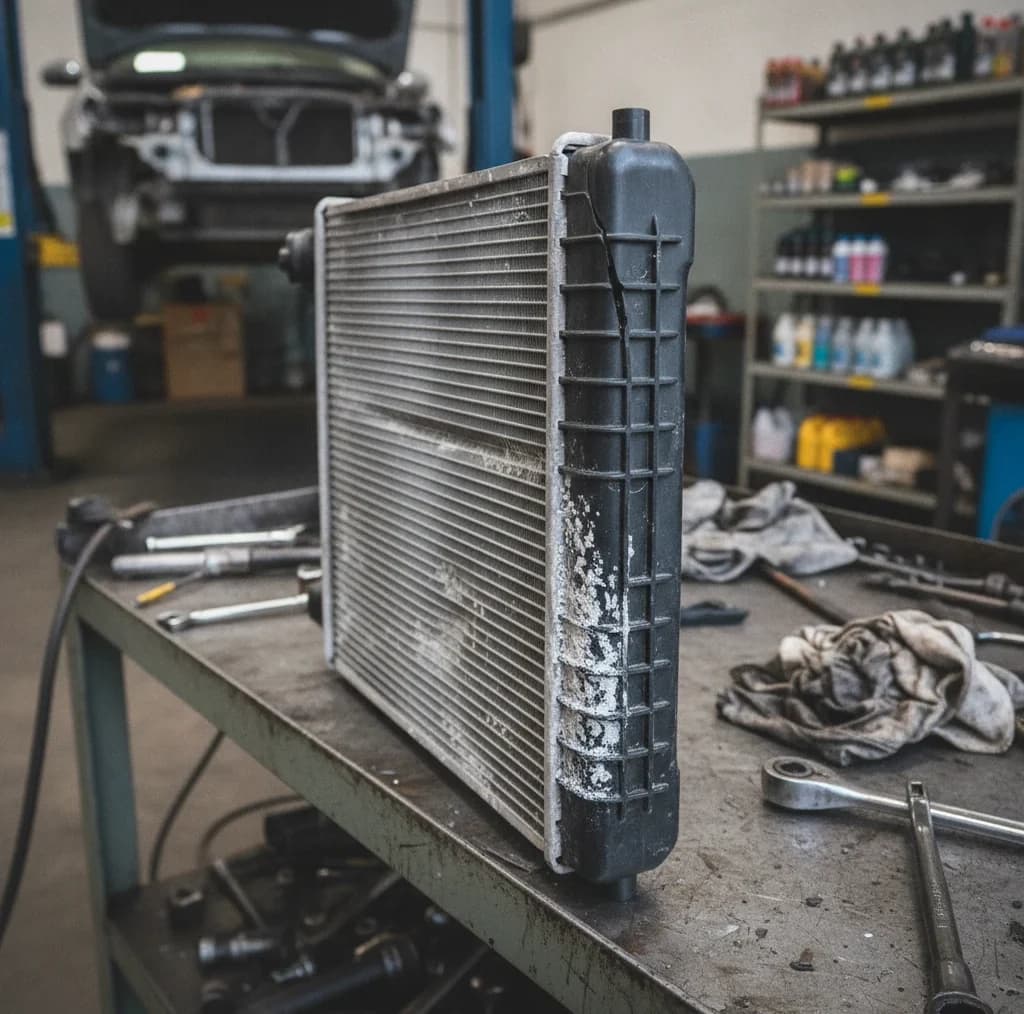
- Plastic end tanks cracking at the crimp seam is the common failure. Check that seam first
- Milky coolant on a truck means the transmission cooler failed inside the radiator, which is a different and worse problem
Cost by route
| Route | Part | Labor | Total |
|---|---|---|---|
| Dealer (OEM) | $250-$600 | $250-$500 | $500-$1,100 |
| Independent shop (aftermarket) | $100-$300 | $250-$500 | $350-$800 |
| New aftermarket, DIY | $80-$250 | Your labor | $95-$290 |
| Salvage yard, DIY | $30-$60 | Your labor | $45-$100 |
Add $15-$40 for coolant either way. Use the specified type; mixing an OAT coolant with a conventional green one produces a gel that blocks the core you just installed.
Where used actually wins
This is the part where we talk you out of a sale. A new aftermarket radiator for a common car is $80-$150 with a warranty. Saving $60 on a used one with unknown history is not a good trade.
The exception is applications where new is expensive:
- Trucks with an integrated transmission cooler. OEM units run $400-$800 and the yard price is the same flat rate as anything else.
- European models. A BMW or Mercedes radiator assembly with the fan shroud and expansion tank can be $500-$900 new.
- Older or low-production vehicles where aftermarket support has dried up and the only new option is a dealer order.
- Cars where the radiator comes as a full cooling module with condenser and fans. Pulling the whole module used is far cheaper than sourcing pieces.
Checking a used radiator in the yard
- Look at the crimp seam where the plastic tank meets the aluminum core. White or brown crust means it has been weeping. That is the failure you are trying to avoid.
- Check the fins. Flattened or corroded sections reduce capacity. A few bent fins are fine; a green powdery core is not.
- Look inside the filler neck. Rusty brown sludge means the cooling system was neglected and the core is partially blocked.
- Check for impact. A radiator from a front-end collision car may be bent even if it is not leaking. Sight along the core.
- On trucks, look at the transmission cooler fittings. Pink or milky residue means the internal cooler failed and cross-contaminated. Leave it.
- Take the mounting bushings and the fan shroud. They are usually free with the part and always missing when you need them.
Why the radiator failed matters
A radiator is often a symptom. Replacing it without checking why it went can mean doing the job again.
| Cause | Sign | Also fix |
|---|---|---|
| Age and heat cycling | Crack at the tank seam, no other issues | Nothing. Normal wear |
| Overheating from another fault | Radiator failed soon after a thermostat or water pump problem | Diagnose the original cause |
| Corrosion | Brown sludge, multiple pinholes | Flush the system, check the heater core |
| Failed cooling fan | Overheats in traffic, fine at speed | Fan, relay, or fan clutch |
| Head gasket | Bubbles in the coolant, coolant loss with no leak | Head gasket. The radiator is not the problem |
That last row is the one to rule out before spending anything. A combustion leak test kit is about $40 and tells you in five minutes whether exhaust gas is getting into the coolant. If it is, a new radiator changes nothing.
Doing the job
Radiator replacement is one of the more approachable DIY jobs. Drain, disconnect two hoses and the fan wiring, remove the shroud, lift it out. The complications are consistent across cars: the lower hose is always seized to the neck, the transmission cooler lines need a disconnect tool on many trucks, and the AC condenser usually sits in front and has to be unbolted and moved without disconnecting refrigerant lines.
Refilling is where people create their own problems. Air trapped in the block reads as an overheat even with a perfect radiator. Use the bleed screw if the car has one, park nose-up if it does not, run with the cap off until the thermostat opens, and top up as the level drops.